Previously: Abandoned Places You Can Actually Visit.
You’ll find phrases like these all over the internet: “This is the most haunted house in America!” “It’s the scariest amusement park that ever opened its gates!” “This town is the most mysterious town in the world!” But if there’s one thing I’ve learned in my decades as a researcher, it’s that places described in this way — that stories that begin like this — are often too good to be true. Indeed, many of these so-called “most haunted,” “most frightening,” “most hair-raising” locations? Aren’t even real. So, in the interest of both fun and transparency this Halloween season: Let’s take a look at the scariest places in the world that don’t actually exist, shall we?
To clarify our terminology here, what I mean by “places that don’t actually exist” are locations — buildings; towns; train stations; amusement parks; the umbrella here is large — which, although often spoken of as being real, exist only in legend. There’s no official record of these places ever having been built or operational; you can neither visit them now, nor would you have been able to visit them in the past, because they were never really there to begin with.
[Like what you read? Check out Dangerous Games To Play In The Dark, available from Chronicle Books now!]
The fun of these stories, though, has always been the way they flirt with reality — the way they make it seem like you can visit them, if you were only resourceful enough to be able to find where they actually are. This quality, however, can also become something a liability; trying to find or visit a place that doesn’t actually exist can be downright dangerous.
So: If you’ve ever wondered, “Hey, is that supposedly haunted house I heard about actually real?”, or “Gee, I’d like to try to find that weird town I keep hearing people mention” — here are the scariest places that don’t actually exist, and the tales that go along with them.
Because it’s still fun to think about, say, a town that inexplicably disappeared or a train station that might take you to another plane of reality, right?
Let’s tell some scary stories, friends.
Congelier Mansion, Pittsburgh, Pa.
Frequently referred to as the most haunted house in America, the once-grand building said to have formerly been located at 1129 Ridge Avenue in the city of Pittsburgh was, reportedly, a house of horrors.
The story usually comes in three parts.
First, we have its namesake: Built by Charles Wright Congelier in the years following the American Civil War, Congelier Mansion, as it would become known, saw the bloody collapse of Congelier’s marriage — and several lives — due to his own infidelity. When his wife, Lyda, learned of her husband’s indiscretions, she was said to have taken butcher’s knife and a meat cleaver to Congelier and the family’s maid.
Second, we have a good old fashioned mad doctor tale: In 1901, the doings of Dr. Adolph C. Brunrichter, who had reportedly purchased the house after several decades in which it had sat vacant following the Congeliers’ murderous end, were exposed — terrible experiments into immortality. Then Brunrichter vanished, and the mansion sat vacant again, though not for long.
And third, we have Congelier Mansion’s demise: In 1927, it was leveled in a gas explosion, bringing its reign of terror to a close.
Trouble is, there’s no evidence that any of this ever actually happened — there’s no record of the existence of a Charles Wright Congelier or a Lyda Congelier living in Pittsburgh during the Reconstruction; no record of the existence of Dr. Brunrichter; no record, indeed, that a mansion ever stood at 1129 Ridge Avenue: Only a row house, built not during the 1860s, but in the 1880s. Furthermore, all of the photos floating around on the internet that claim to depict Congelier Mansion are all demonstrably other places.
The alleged “Congelier Mansion” remains Pittsburgh’s haunted house that never was.
Doveland, Wisconsin
The details about Doveland, Wisconsin are scant even before we get to the bigger mystery at play with regards to the story: All that’s ever really said is that Doveland was a small town in Wisconsin that, somehow, disappeared entirely sometime in the late 1980s or early 1990s. Every person who lived there vanished, and the town itself was wiped from the earth. What’s more, no one ever properly remembers Doveland, either; it’s as if any memories anyone might have held of the place were wiped away, too.
Possible explanations for what happened to Doveland range from its residents leaving of their own accord to the town being razed as part of a larger conspiracy; there’s even one proposal that suggests the town “fell into another dimension,” and that the rest of us “shifted to a reality where the town had never existed” à la the Mandela effect.
More likely, though, is that it’s a legend born of the internet circa 2017. Why 2017? Because there’s no trail at all to find that’s dated earlier than that, and from 2017 onwards, it’s always the same pieces of “information” being traded back and forth. It’s not quite a copypasta, but it’s close — and as far as the record goes, there’s no mention of Doveland not because it was wiped out of existence, but because it never existed in the first place.
Ashley, Kansas
Ah, yes, a personal favorite: Ashley, Kansas. One of the earlier internet-based vanishing town legends, this one alleged that a small town in Kansas — the aforementioned Ashley — disappeared in 1952 following a massive earthquake. Not only had the town itself vanished, however; upon investigation, all 678 residents were also found to be missing. All that remained of the place as a “smoldering, burning fissure in the earth,” stated reports at the time.
What’s more, after a subsequent earthquake not long after the first, that “smoldering, burning fissure” was found to have closed itself back up — though the town of Ashley, Kansas and all its residents remained missing.
And still later, it was allegedly found that in the eight days leading up to that first earthquake, a number of increasingly odd and disturbing incidents had occurred. These incidents ranged from openings appearing in the sky to the people in the town somehow having conversations with friends and loved ones long dead — all while a mysterious fire burned.
The town was never recovered. Nor were its residents.

This one, though, has a very clear source: A creepypasta/NoSleep story titled “The Disappearance Of Ashley, Kansas,” published by CoasterKid at both the Creepypasta Wiki and r/NoSleep in April of 2012. It’s a terrific story — a classic (indeed, I think it’s not unlikely that “The Disappearance of Ashley, Kansas” could have inspired the Doveland story and others like it), and one I recommend anyone with even a passing interest in creepypasta and other forms of internet-based horror storytelling check out — but it is just that: A story. There’s no record of any of its events ever occurring in real life. (See also: The entry on Ashley, Kansas in my “Is It Real?” series from my Vault Of Deep Cuts.)
For a long, long time, though, it wasn’t unusual for me to find terms like “Ashley Kansas real,” “is Ashley Kansas real,” “did Ashley Kansas disappear,” and other similar phrases in my analytics here, which has always struck me as interesting.
Himuro Mansion
Another favorite: Himuro Mansion, also sometimes called Himikyru Mansion, aka the Fatal Frame house. Outside Tokyo, it’s said, there are the ruins of an old mansion — one that dates back at least to the Edo period, though it’s possibly even older — where terrible things once took place.
A murder, for one thing — though not just a single murder; seven murders, all on the same night.
A ritual, for another — one involving ropes and maidens and calamities.
And, of course, a haunting — it’s said that, should one take a photograph of a certain window, the figure of a girl will be visible in the developed image… even if the window was empty at the time the photograph was taken.
All of this, it’s said, was the inspiration for the 2001 video game Fatal Frame, making an already terrifying gaming experience even more frightening.
Alas, though, it’s become pretty clear in the decades since that Himuro Mansion is itself not a real place.
For many years, an oft-quoted sound byte from Fatal Frame director Makoto Shibata was constantly pointed to as evidence of both the mansion’s actual existence and its alleged history. This sound byte was never sourced, though; it was always described as something Shibata had said “in an interview,” but without any firmer citation than that: No article title; no publication name; no byline; no date; absolutely nothing.
I did eventually discovered that it wasn’t even “an interview” at all; it was a press release: that is, marketing material produced specifically for the North American release of Fatal Frame, which — unlike the original Japanese release — originally positioned the game as “based on a true story.” It was, however, only based on a true story in the way that The Texas Chain Saw Massacre and The Blair Witch Project are — that is, not at all, really; just made to look that way for extra scares.
So: No, Himuro Mansion doesn’t exist, despite what many still claim. It’s a good story, though, isn’t it?
Pennyland Amusement Park, Manitoba, Canada
Outside of Winnipeg, not too far from the U.S.-Canadian border, there was once an amusement park called Pennyland — an amusement park which later became known not for its fun and games, but as the setting of a number of tragedies. No wonder it gained a reputation as one of Canada’s most haunted places.
Or at least, that’s what the stories would have us believe. But there’s a lot here that follows the path of the Congelier Mansion story — starting with the fact that the Pennyland saga comes in three parts.
First, there was an alleged accident on the Ferris wheel — one that goes undescribed, but which is said to have resulted in the deaths of several riders. Pennyland had to shut down for a while after that, and although it did try to reopen, poor attendance due to the continuing stigma of the accident prevented it from succeeding, resulting in its gates closing for good again shortly thereafter.

Second, there was the serial killer: One night, the remains of several people — two victims, one perpetrator — were uncovered in the decaying buildings of the abandoned park.
And third, there was the haunting: It’s been said that, ever since, venturing onto the grounds of the abandoned Pennyland amusement park at night might put you face to face with one of two things. You might witness the spirit of the young woman dancing in a crumbling pavilion; or, less entrancing, you might see the stone tape-style replaying of one of the murders carried out by the serial killer.
But guess what? Like Congelier Mansion, Pennyland isn’t real. It never has been; it was fabricated in its entirety for the television program Creepy Canada, which originally aired on the Canadian network OLN between 2002 and 2006. The episode depicting “Pennyland” was shot largely in Kentucky, not Manitoba. And — again, as was the case with Congelier Mansion — pretty much every photograph or piece of video footage that was originally pointed to as evidence of “Pennyland’s” existence has since been identified as being of somewhere completely different.
Case closed on Pennyland.
Hoer Verde, Brazil
There are a few different versions of the Hoer Verde story floating around, but the broad strokes are these:
In 1923, a small group of visitors arrived in the small town of Hoer Verde, only to find it completely empty. There was no sign of violence — not even any indications of mild struggle; everything had just been… left as it was. Its inhabitants, however, were gone. All they left behind was a message written on a chalkboard in the village’s small schoolhouse: “There is no salvation.”
The mystery of what happened to the residents of Hoer Verde, Brazil has never been solved.
That, however, is because there is no mystery of what happened to the residents of Hoer Verde — because there never was a Hoer Verde. The tale is clearly heavily influenced by the real-life Roanoke mystery (which has also been mostly solved at this point), but it remains just that: A tale.
Honestly, the real story here isn’t even what happened to Hoer Verde, but how the story of Hoer Verde became so pervasive — how the legend of the disappearing town in Brazil came to be, and how it spread, and how the fictional village at the center of it even became known as Hoer Verde in the first place.
Curious about that? Head here. It’s a wild one, friends.
Urkhammer, Iowa
Have you heard of Urkhammer, Iowa? You could be forgiven if you hadn’t — and not just because the size of the town (tiny, for the curious) was such that most wouldn’t know of it, unless they were local. But it would be understandable if you had no awareness at all of Urkhammer, Iowa even if it were bigger, or if you were local… because it had allegedly vanished by 1932.
It didn’t happen all at once. It was slow: Over the course of several years, beginning roughly around 1928, bits of the town simply became… inaccessible. Aerial photographs taken of it began showing only empty fields; motorists who filled their tanks at Urkhammer’s one and only gas station found the fuel to have mysteriously disappeared not too long after leaving the town’s limits; and, in at least one case, travelers attempting to enter the general store found they were unable even to mount the shop’s steps, as they had turned spectral and insubstantial. By May of 1932, anyone who passed through where Urkhammer had once been found only fields and empty space.
Although this one is yet another “Small Town Vanishes Off The Face Of The Earth” tale that is, on the surface not unlike Doveland, Ashley, or even Hoer Verde, what makes Urkhammer different is that it just sort of… faded away. There was no specific incident that resulted in the wiping out of the town entirely; the idea of it simply grew thinner and thinner over time, until eventually, it just disappeared. Out of sight, out of mind, as the saying goes.
But Urkhammer, of course, didn’t actually vanish, because it never existed in the first place. The story itself originated over at Cullan Hudson’s blog Strange State; per Hudson, his mother had located the tale while cleaning out her email inbox and sent it to him, thinking he might find it of interest. He was pretty sure it was a fun piece of fiction, and subsequently posted it in 2015 — only for numerous other blogs and websites to pick up the tale and report it as if it were true. So, when the tale spread, it was frequently erroneously interpreted as real, due to the constant omission of the fact that it was just a fun writing exercise.
The internet is a strange, strange beast.
The Otherworld Train Stations Of Japan
The wide array of kowai hanashi — literally “scary stories,” though perhaps best understood as Japanese creepypasta — littering 2ch/5ch are full of tales of train stations. These stations, though? They’re… not the kind you want to find yourself pulling into. And if you do, you definitely don’t want to take a chance and debark while you’re there.
Kisaragi Station is probably the most well-known of the bunch; originally posted to 2ch in 2004 (more than 20 years ago!), its story took the form of a thread written by a poster seeking help as they realized their train home had gone somewhere they hadn’t expected. Kisaragi Station, this poster found when their train pulled in, was seemingly empty — and as the train sat longer and longer in the empty station, the poster began to get nervous. When they exited the train, however, it pulled away immediately, leaving them stranded… and although it seemed that eventually, the poster had found help, they were never heard from again.
The station’s name, the poster had noted, was written using the kanji for “demon”: 鬼.
But Kisaragi Station is far from the only otherworldly train station, or ikai station, best avoided by the cautious traveler. Hitsuka Station, for instance — described by its original 2012 2ch/5ch post as “colorless” — puts travelers in contact with a child who is definitely not a child, at a station they’ll soon discover is “one step before death.”
Or the “unreadable station” — a station with a name that, oddly, those who find themselves at will not be able to read, even if though the characters on the sign will look familiar: They just… won’t resolve themselves into actual words. Additionally, upon returning to their own world, these travelers will also find that everyone they know — friends, colleagues, loved ones — will seem like strangers to them. It’s as if they, too, have become unreadable — or as if the traveler will have become unreadable.
Good thing none of them are real, right? They are, all of them, stories. Chilling stories — stories that are fun to read about to send a shiver down your spine, and ones which, particularly in the early days of online horror, took advantage of the way the internet can blur the lines between reality and fiction — but stories nonetheless.
The Chimera House
For decades — at least since the late 1980s — people have passed around stories about a haunted attraction so frightening, you’d get your money back if you made it through the whole thing. Or maybe you’d get a bigger prize — a flat fee much greater than the price of admission. Or maybe you’d get incremental amounts of money back for each floor you made it through. Reports varied widely — just as they varied as to the nature of the haunt, its variety of venue, its geographic location, and more.
It was inside an abandoned hospital. It was inside an old warehouse. It was inside a shut-down factory. It had two floors — three floors — five floors — seven floors — 13 floors (lucky 13). It was in Texas; Ohio; Missouri; Michigan; California; Pennsylvania; Illinois; North Carolina; Georgia; somewhere else. It ran only at Halloween, or maybe it ran year ‘round.
It has gone by many names in all of these stories, but the one that pops up the most often is the Chimera House.
As far as I’ve been able to tell though — and I have done a lot of digging over the years — the Chimera House has never actually existed. Not in the form that the stories insist, at least.
But interestingly, elements of the Chimera House story have made their way into actual haunts from time to time, especially during the late 2000s and early 2010s: At that time, “extreme” haunts were on the rise, and it became not uncommon for more run-of-the-mill haunts to add some auxiliary experiences — for an additional admission fee, of course — that upped the ante, and in some cases (Hustonville, Kentucky’s “Panic Room” at the Nightmare On Main St. haunt, for instance) did offer your admission fee back if you completed them.
The Chimera House legend is most notable, however, for its influence in further fictional arenas: The haunt within the classic creepypasta “NoEnd House” — which, in turn, also formed the main conceit of the second season of Channel Zero — is functionally a Chimera House… and then some.
It still isn’t real, though. Mostly.
Langville, Montana
There is vanishingly (har har) little information about Langville, Montana available; most of what we have amounts only to another “disappearing town” situation. Most retellings of the story state only that the town’s inhabitants all disappeared inexplicably and without a trace, leaving the place completely deserted; a few, however, add a rather colorful detail to the mix: The assertion that the inhabitants didn’t disappear, but were all… turned inside out. Literally.
Not much more than that is usually said; otherwise, all we have to go on is the timeline, which isn’t consistent: Some sources claim that the town vanished in the early 2000s, while others position the whole “turning people inside out” thing as having occurred a century earlier, in the early 1900s. Of course, it turns out that the reason the details are so scant is that none of it ever happened; indeed, there has never been anywhere in Montana called Langville at all.
What is a bit of a mystery is how the story started and when. It was at its most popular in terms of how often it was getting passed around in 2016, when a reference to Langville very briefly appeared in the Ghostbusters film released that year (alongside equally brief mentions of the alleged 1964 Socorro UFO incident and the S.S. Ourang Medan legend); whether it was actually invented specifically for Ghostbusters, however, remains to be seen.
There’s not much on the internet about Langville that predates the 2016 Ghostbusters, but at the same time, some native Montanans swear that the story has been passed around for ages, so do with that what you will.
At least we don’t have to worry about anyone actually having gotten turned inside out, though.
Japan’s Deadly Villages
Not unlike the many non-existent train stations that wend their way through 2ch, 5ch, and other platforms known for their collections of kowai hanashi, so, too, are there tales of mysterious villages you… probably shouldn’t try to find.
Of these, Inunaki Village is probably the most infamous; a legend that’s been circulating at least since 1999, it tells of a place allegedly located in Fukuoka Prefecture where the Japanese constitution is not in effect. Those foolish enough to venture past the signs stating this fact have subsequently suffered bloody, violent fates, according to the stories.
Similarly, Sugisawa Village, which may allegedly be found in Aomori Prefecture, is said to have been so cursed, it was erased from the map. Like Inunaki Village, ominous signs are supposedly posted outside of Sugisawa Village, although rather than stating that the constitution of Japan is no in effect beyond them, they say — more broadly, and also perhaps more frighteningly — that there is “no guarantee of life” beyond them. Or, put another way: Take one more step and you die. Stories of Sugisawa Village have been circulating at least since 1997.
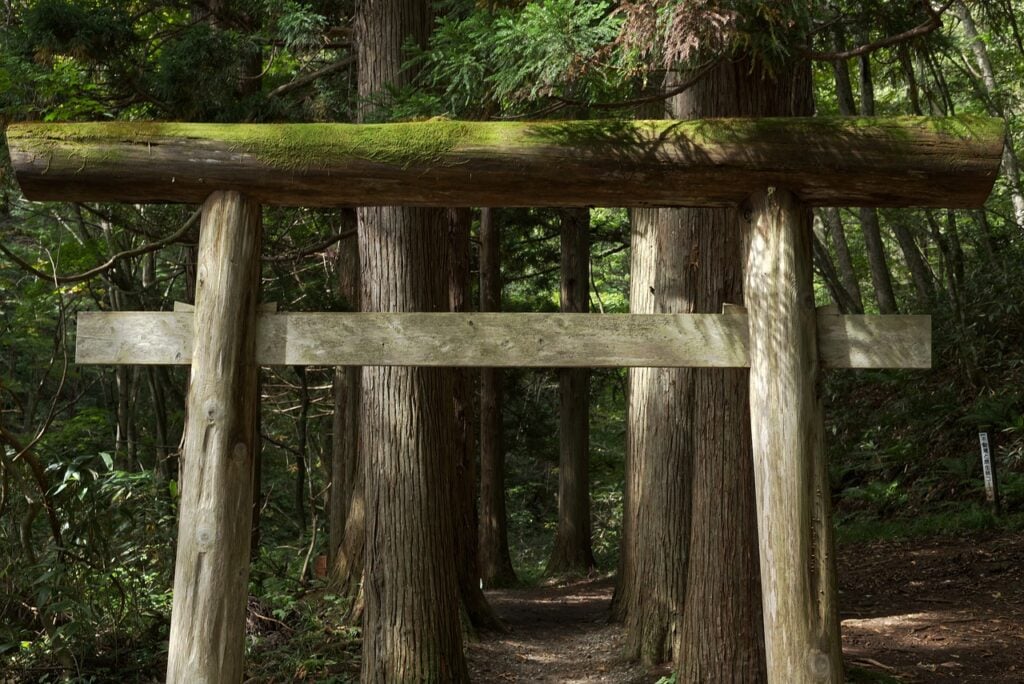
True, there was once an historical Inunaki Village — called, by its full name, Inunakidani Village — during the Edo period; however, this is not the Inunaki Village that features in the various kowai hanashi bearing the name. (It also no longer exists, having been absorbed into the nearby Yoshikawa Village in 1990.) Indeed, Inunaki Village, Sugisawa Village, and the many other similarly deadly villages like them exist only in stories.
So, y’know, do yourself a favor and… don’t try to find them. For your own good, you understand.
Most Of The Locations Featured On MTV’s Fear
I’ve commented before that early-2000s ghost hunting reality television is the only variety of reality television I’ve ever watched with any regularity. I’ve even mentioned how much I adored MTV’s Fear, despite its extremely short lifespan.
It also — in grand reality TV tradition — had very little in it that was actual real, including the majority of allegedly haunted places that served as the show’s filming locations.
Does this make me love it any less? Absolutely not. But it is still interesting to me exactly how much of the show was completely fabricated, often based simply on the appearance of each shooting location — by which I mean, literally, how the places looked. They were old and either abandoned or otherwise no longer functioning as they were originally meant to: That is, they looked haunted; ergo, as far as the show went, they were haunted.
It plays into an idea I’ve floated a few times here at TGIMM before, theorizing how allegedly haunted locations come to be known as such in the first place: Either something terrible happened there, so people think it looks haunted, and begin treating it as such; or, it looks haunted, therefore people begin to think that something terrible happened there, and begin treating it as such, even if nothing of note actually happened there at all.
In any event, of the 15 locations used across the two seasons of MTV’s Fear, eight of them — more than half — were fictionalized, often slapping a story on top of the landscapes that had zero truth to it. In Season 1, which aired between 2000 and 2001, these locations were:
- “St. Agnes Hospital For The Chronically Ill” — actually the Fairfield State Hospital in Connecticut;
- “The Duggan Brothers Cement Factory” — actually the Ideal Cement Company in Castle Hayne, North Carolina;
- “Hopkins Military Academy” — actually the Augusta Military Academy in Fort Defiance, Virginia;
- “Camp Spirit Lake” — actually Camp NoBeBoSco in Hardwick Township, New Jersey (which, fun fact, was also the shooting location for the original Friday The 13th film);
- And “La Guerre Plantation” — actually Desert Plantation in St. Francisville, Louisiana. (I’m refraining from linking here because most of what exists out there on the internet about this place is advertising it as a B&B and a wedding venue, and, uh, I don’t feel great about that!)

And in Season 2, which aired between 2001 and 2002, these locations were:
- “Ki Sugar Mill” — actually Haʻikū Sugar Mill in Maui, Hawaii;
- “Serenity Lake Sanatorium” — actually King Edward VII Sanatorium, later called Tranquille Sanatorium, in Kamloops, British Columbia, Canada;
- And “Boettger Brewery” — actually the Lemp Brewery in St. Louis, Missouri.
Now, it is worth noting that the Lemp Brewery does have an actual haunted reputation, while the story slapped on top of “Camp Spirit Lake” is a fictionalized version of a real-life, then-cold case known as the Princess Doe case. (The Princess Doe case has since been solved and Dawn Olanick’s killer brought to justice.)
However, it is also worth noting that elements of the Lemp Brewery story are… questionable (yes, many of the Lemps did die relatively young and in such quick succession that it’s easy to joke about there having been a curse on the family — but the whole “Monkey Boy” business? That’s… uh… well… let’s call it highly sensationalized); meanwhile, the Princess Doe case occurred in an entirely different township in New Jersey than Hardwick Township — on top of which it was, at best, ethically dubious to use a real tragedy in the way the show did.
My point is, even the “real” stuff played fast and loose with the truth, so for all intents and purposes, “Boettger Brewery” and “Camp Spirit Lake” don’t exist.
One day, I’ll perhaps take a closer look at MTV’s Fear in some kind of full feature retrospective. Today is not that day, though, so for now, that’s where we’ll leave things.
So there you have it: Somewhere in the neighborhood of 22 scary places that don’t actually exist — or, put another way, that exist only in stories.
But oh! What stories! Perfect for telling around a campfire at night, no? Especially at this time of year. So go ahead. Throw another log on the fire. Let me tell you about the time my friend drove through a town they swear wasn’t there when they tried to find it again later…
***
Follow The Ghost In My Machine on Bluesky @GhostMachine13.bsky.social, Twitter @GhostMachine13, and Facebook @TheGhostInMyMachine. And for more games, don’t forget to check out Dangerous Games To Play In The Dark, available now from Chronicle Books!
[Photos via NickTaylor2020, na4ev, jplenio (1, 2), tmeier1964, HiQ-Visions, dep377, ScenicRoute69/Pixabay]
Leave a Reply