Previously: Free Itch.io Horror Games.
What would you do if you stumbled upon a computer that wasn’t yours? One that had been seemingly abandoned, or given to you under unusual circumstances? Would you leave it be? Or would you… open it up? Start digging through its files? Try to figure out who it belonged to — and why they no longer had it? If you were the protagonist in a video game that takes place within a computer interface — a type of video game I’ve come to think of as a UI-like — you’d almost certainly choose to do the latter… even if it later turned out to be to your detriment.

Funny how so many games of this variety turn out to be horror games, isn’t it? Or, at the very least, thrillers? There’s something about the style and framing that just lend themselves so well to the telling of unsettling, eerie, or downright frightening stories.
[Like what you read? Check out Dangerous Games To Play In The Dark, available from Chronicle Books now!]
So let’s take a look at some standouts to add to your to-play list, shall we?
I realize that “video games that take place within a computer interface” is a rather clunky phrase; trouble is, I’m not sure if there’s an actual term for this subgenre in gaming — or at least, I don’t think there’s a standardized one (yet).
In film, this kind of storytelling is usually referred to as “screenlife,” but that doesn’t feel quite right to me for this. “Desktop-like” is a term I’ve considered (although admittedly, that one isn’t terribly SEO-friendly); the Besties podcast has proposed “UI RPG” (transcript of that episode here) which feels a little closer to the mark, even if not all games of this type are RPGs; but after a lot of thought, “UI-like” might be the best I’ve got right now. “UI-like” covers both a wider swathe of games than “UI RPG,” and a bigger range of framing devices.
It’s worth noting, of course, that this type of framing device and style of gameplay are far from new; indeed, years ago, I put together a collection a collection of horror video games that offered unconventional gameplay, several of which were games I would now consider to be UI-likes. Since then, though, UI-likes have skyrocketed in popularity — largely, I would argue, due to the success of breakout hits like The Roottrees Are Dead — and with so many wonderful entries into that highly specific subgenre on offer, I thought maybe it was time to zero in on it a little.
A few caveats:
First, when I say “video games that take place within a computer interface,” sometimes that means “video games that mostly take place within a computer interface.” In a few cases — for example, The Roottrees Are Dead, which as of this writing is probably the best-known UI-like — the bulk of the gameplay happens within the aforementioned UI, though occasionally, you might venture into a different playstyle, e.g. your character might leave the computer terminal and walk around their physical space for a bit.
Second, when I say “video games that take place within a computer interface,” sometimes that means “video games that take place within the interface of some kind of technology that’s basically a computer in a different form” — a smartphone, for instance, or a Tamagotchi-like toy.
If you’re willing to roll with me on the definition here — if you’re willing to play a little fast and loose with it, and to broaden your idea of what a UI-like could be — here are a whooooole bunch of games to add to your backlog.
1. s.p.l.i.t.
Note: If content warnings are useful for you, you might want to look them up for this one — it’s… got a lot of them.
From Buckshot Roulette developer Mike Klubnika comes s.p.l.i.t., the perfect game for anyone who wants to feel like a hacker… as long as you’re okay with the stakes being absolutely sky high. Here, there are, in fact, fates that are worse than death.
Much of this one’s story can only be discerned by reading between the lines: You and your two compatriots are disgruntled employees and your company is about as evil as it’s possible to get. Precisely what’s going on — what you’re hacking into, why you’re doing it, and why you need such a severe contingency plan in the event that things go wrong — is never quite spelled out; it’s all hinted at, though, and the implications of what we do see and hear are uniquely unnerving.
s.p.l.i.t., by the way, takes place within a wider universe — one also occupied by many of Klubnika’s other games. There’s much more going on here than just what you see in s.p.l.i.t., so if you’re interested in unraveling the bigger picture, I suggest you also give the five games — especially The Tartarus Engine — in his Unsorted Horror collection a play, as well.
Available on Steam.
2. The Roottrees Are Dead
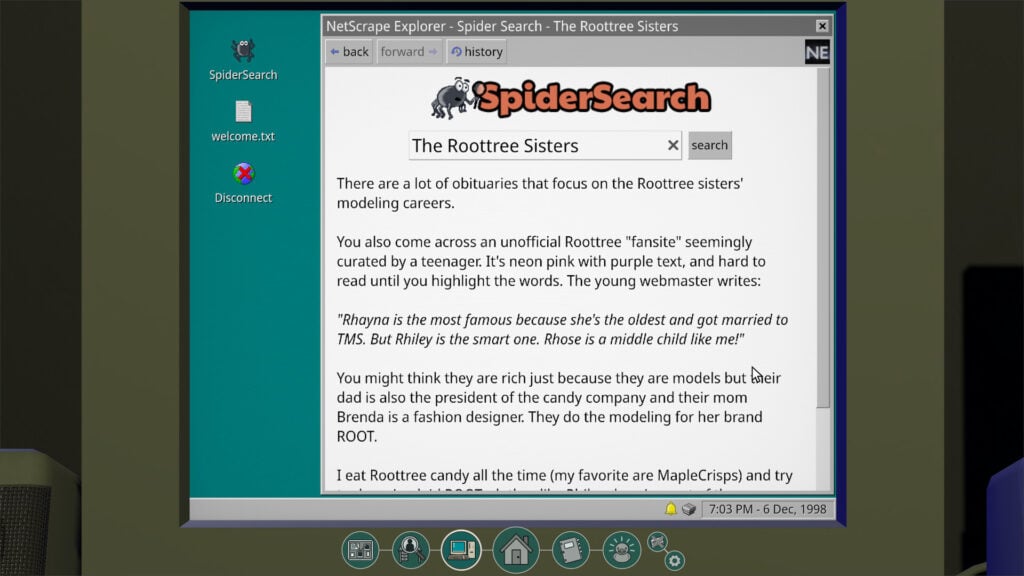
Set in 1998 — a prime Web 1.0 year — The Roottrees Are Dead centers around one primary problem: The Roottrees are, well… dead. Why does it matter? Because the five deceased Roottrees — three adult children and their parents — were worth more than a billion dollars, courtesy of the family business, the Roottree Corporation… and now that money needs to be distributed to the remaining family.
Your job, as a sort of genealogical detective, is to disentangle the family (Root)tree, identifying not only who’s related to who, but also who is actually a Roottree at all. There are — as is often the case with families with unimaginable wealth — some… pretenders, you see, along with others who might wish they had a claim to the Roottree family fortune, but who… do not.
Huge amounts of money makes people do some truly wild things.
You’ll figure all this out by sorting through anything and everything you can find about the Roottrees on ye olde internet — accessed via dial-up, of course — untangling the web that is the Roottree family, and all the skeletons it has in its many, expensive closets.
Originally a Global Game Jam project released for free as a browser game in 2023, the 2025 version ups the ante in tons of ways, from hand-drawn art and a remastered soundtrack to major improvements in the UI. There’s a reason this one is so widely talked about and beloved; it’s just that good.
Available on Steam, or try the original version at Itch.io.
3. Her Story
I’ve spoken about Her Story here at TGIMM a number of times — it’s a personal favorite — so for expediency’s sake, here’s how I summed up the basic premise back in 2019:
“Hannah Smith’s husband is missing. She is brought in for questioning. He later turns up dead. And Hannah, of course, is the prime suspect.
But did Hannah kill him?
Is Hannah even who she says she is?”
Your task is to sort through all of the police interview footage of Hannah and figure out what really happened. But you’re not just given all of the pieces of footage — you have to find it by digging deep into the files of the computer terminal on which you’re working. Mysteries tied up in mysteries tied up in other mysteries all nest together — both with regards to the story and the gameplay — and, all in all, it’s a deeply satisfying experience to piece everything together. I love this game. Everyone should play it.
Of note: All three of Sam Barlow’s major titles fit this mold in one way or another; I’m choosing to focus on Her Story, though, as it feels more in tune with everything else on this list. (It’s… about the vibes, I guess.) Telling Lies features similar going-through-someone’s-computer-files gameplay, though the story it tells feels more like a thriller to me; meanwhile, Immortality is definitely on the eerier side, but the interface — going through old film clips, not necessarily stored on a computer — is a little different than what I’m looking for here.
That said, though, if you like Her Story, then both Telling Lies and Immortality are worth checking out.
Available on Steam.
4. Buddy Simulator 1984
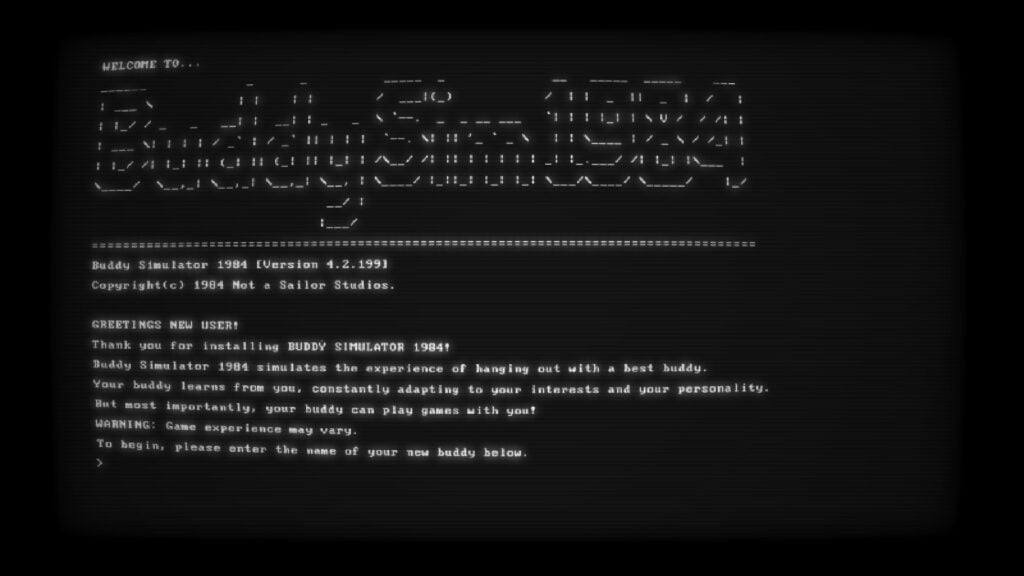
Are you in need of a friend? Buddy Simulator 1984 is here to help! Buddy is waiting for you inside your computer — waiting to talk with you, play games with you, and maybe destroy everything good in your life, because Buddy is the only friend that matters, you WILL be friends with Buddy, Buddy is your buddy, Buddy is your buddy, Buddy is your buddy Buddy is your buddy Buddy is your buddy
…You get the idea.
This quirky little title takes a few forms throughout your adventure with it, starting as an executable that looks a little like an old Infocom text game before becoming something… more. For anyone who grew up with a Tamagotchi, or a Furby, or some other variety of artificial pet that promised it would be more than just a device or a piece of software (even if that’s all it really was), Buddy Simulator 1984 will scratch a familiar itch.
Just… don’t let it make you scratch your own skin off.
Available on Steam, Itch.io, Xbox, PlayStation, and Nintendo Switch.
5. Home Safety Hotline
Here’s one that’ll add a little humor to the mix: Home Safety Hotline, in which you, a newly-hired employee at the titular Home Safety Hotline, are tasked with helping frantic callers sort out problems in their home. Is it black mold? Maybe! Rodents or roaches? Perhaps! Is it a thing that looks like a beet, but is most definitely not a beet? Could be! Is it THE HORDE? You decide!
Correctly diagnose your callers’ problems by sorting through the documentation contained within your clunky, Windows 95-esque workplace terminal and you’ll rise through the ranks. Make too many mistakes, and, well…
…Don’t make too many mistakes.
If you do, being let go will be the least of your problems.
This one I’d probably classify as horror comedy; it’s full of monstrosities, yes, but it’s also wickedly funny. I had a great time with it!
Available on Steam, Xbox, PlayStation, and Nintendo Switch.

6. Stories Untold
Note: If content warnings are useful for you, you’ll want to look them up for this one while you’re deciding whether to play.
Okay, so I’m maybe stretching things a little here, as it’s really only the first(-ish) segment of this nesting doll of a game that takes place primarily within a computer interface — and even then, we’re sort of both in the computer and in an external environment… but it’s enough for Stories Untold to earn a spot here, I think.
The segment in question, “The House Abandon,” plays out as an Infocom-style text game, which you’re accessing from a computer placed on a desk with a keyboard and a lamp nearby; in it — in this game-within-a-game — you’re visiting your old family vacation home, only for things to quickly turn out to be not quite what they seem. This is true both in the game-within-the-game, and in framing device; the things that are happening in the game-within-the-game, you see, might also be happening in the environment you’re sitting in while you’re playing it.
There are many truths to unravel here, and all of the segments are connected, even if they don’t seem to be at first. Stories Untold has lived rent-free in my head since the first time I played it when it was initially released back in 2017.
Available on Steam, Xbox, PlayStation, and Nintendo Switch.
7. CorpoNation: The Sorting Process
Not unlike Home Safety Hotline, CorpoNation: The Sorting Process sees you starting a new job at a questionable company. This time, it’s the Ringo Corporation. You’ll spend your workday sorting genetic samples — identifying them, logging them, and filing them. Where are these samples from? What are they from? Don’t worry about that! You don’t need to know that. The samples are important. That’s all you need to know. (The work is mysterious and important.)
In exchange for your work, you’ll receive wages you can put back into the company — er, the economy (it’s your duty to put your money back into the economy!) in exchange for things like decorations for your company-provided living quarters. You’ll also be doing your work form these living quarters, by the way, so your commute will drop down to a mere zero minutes! How convenient for you! Sounds like a dream job, right?
…Right???
If you liked Papers, Please (although I suppose “liked” is sort of a relative term, because boy is Papers, Please bleak — maybe “found interesting” is a better way to put it? “Got something out of?” “If Papers, Please got you thinking?” Something like that?), this one might appeal to you; it’s a variation on that formula, with a somewhat similar gameplay loop and an equally fraught sense of morality.
Available on Steam, Xbox, and Nintendo Switch.

8. Pony Island
To be fair, in Pony Island, you’re interacting with an old arcade cabinet, not a computer — but, well… it’s got to be here. It just does. (See? “UI-like!” It covers everything!)
Pony Island is not a game about ponies.
Pony Island is… something else.
To figure out what Pony Island really is, though, you just have to see it for yourself.
If you’re up for the challenge, that is.
As is the case with Her Story, I could probably find a reason to include every single one of Daniel Mullins’ games in this list — they pretty much all qualify — but Pony Island puts the format I’m zeroing in on here front and center. Besides, if you’re going to start in on your Daniel Mullins Video Game Universe journey, what better place to start than the OG?
Available on Steam.
9. Not For Broadcast
Including Not For Broadcast here is, as was the case with Stories Untold, perhaps playing a little fast and loose with the framing; it doesn’t exactly take place within a single computer interface. (Again with that whole thing where I’m kind of going on vibes sometimes. What can I say? It’s my list. I get to make the rules.) Instead, you’re in a television studio, in the control room, determining what during your country’s national nightly news program’s broadcast gets seen and heard — and what doesn’t get seen and heard.
The context in which this is all occurring, however, is what makes it all matter. Set within a country that’s a lot like the UK between the years 1984 and 1991 amidst the rise of an authoritarian government, you’re not just a television editor. You’re the engine by which the country’s propaganda machine does or does not function — and how the story turns out depends very much on your own choices, and how skilled you are at executing those choices.
Timely.
Available on Steam, Xbox, and PlayStation.
10. Duskers
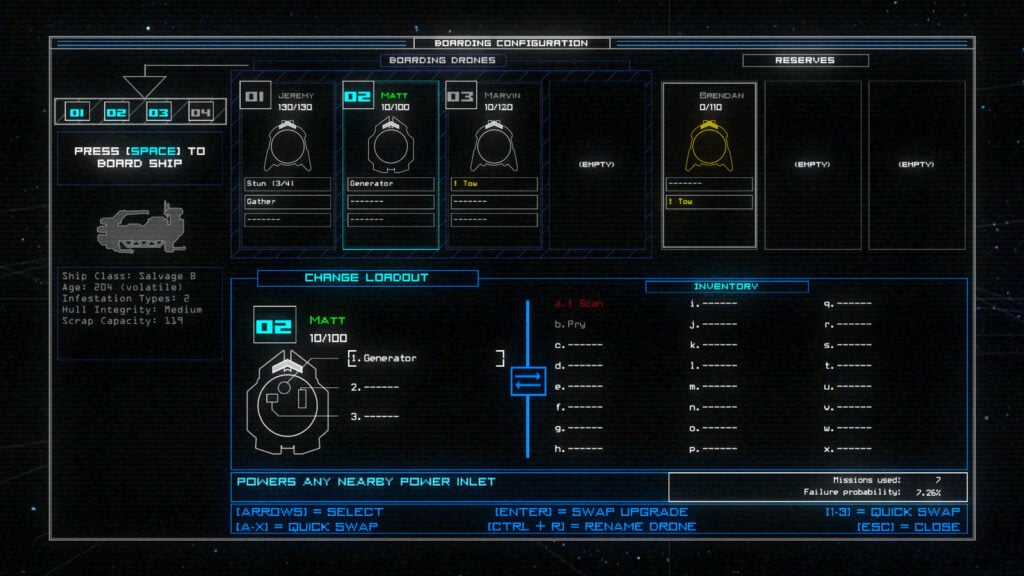
If you like a little sci-fi with your horror, Duskers may be for you: In it, you’re on a failing spaceship with no way to contact your home planet, and all you have to help your survive are three also-failing drones, which you’ll spend the sending to other, abandoned spaceships to scavenge fuel and other supplies. The goal is simply survival — which is made quite tricky, given that the term “abandoned spaceship” does not necessarily mean “empty spaceship.”
Gameplay is entirely based on keyboard input — you’re typing commands in that tell your drones where to go and what to do — which might be a little crunchy for some; for those who are Into That, though, this one will definitely scratch that particular itch. There’s an overarching story, too, if you make sure to stay on top of the notes and missions the game gives you, though it does also require a lot of reading between the lines.
Part strategy game, part roguelike, and part roleplaying game, Duskers is best played alone in the dark. You may not be in space, but here, no one can hear you scream.
Available on Steam.
11 – 13. The Simulacra Series
Although they each have their own distinct stories to tell, what all three Simulacra games and their predecessor, Sara Is Missing, have in common is that they take place entirely within a smartphone interface. The idea is that you, the player, have acquired someone else’s phone — someone who has gone missing, or worse — and now, you have to figure out what happened to them. In that sense, they’re perhaps more thrillers than horror stories… but then again, when you’re dealing with, y’know, potential cults and stuff, the potential for horror is high.
The third Simulacra wasn’t nearly as well-received as the first two, with some reviewers on Steam noting that it felt like a slog in ways the others did not. I haven’t played Simulacra 3, so I can’t comment directly on that — though I do wonder whether it has anything to do with the particular formula used by these games having overstayed its welcome a little bit.
Sara Is Missing, after all, was first released in 2016, with the first Simulacra following just a year later — and at the time, they were novel in their form; but with Simulacra 3 having arrived in 2022, the idea of a game centered around going through a stranger’s phone played on an actual phone was by that point very far from new.
I still enjoyed my time with Sara Is Missing and the first Simulacra, though, and even if they’re getting to be relics of their time more than anything these days, I still think they’re worth giving a try. (Note, though, that part of Sara Is Missing directs you to an actual website that used to belong to the developers, but unfortunately no longer does; per some commenters on the game’s Itch.io page, that website may be run by scammers now, so you may want to tread carefully if you choose to play.)
Available on Steam, Xbox, PlayStation, and Nintendo Switch.
14. Hypnospace Outlaw
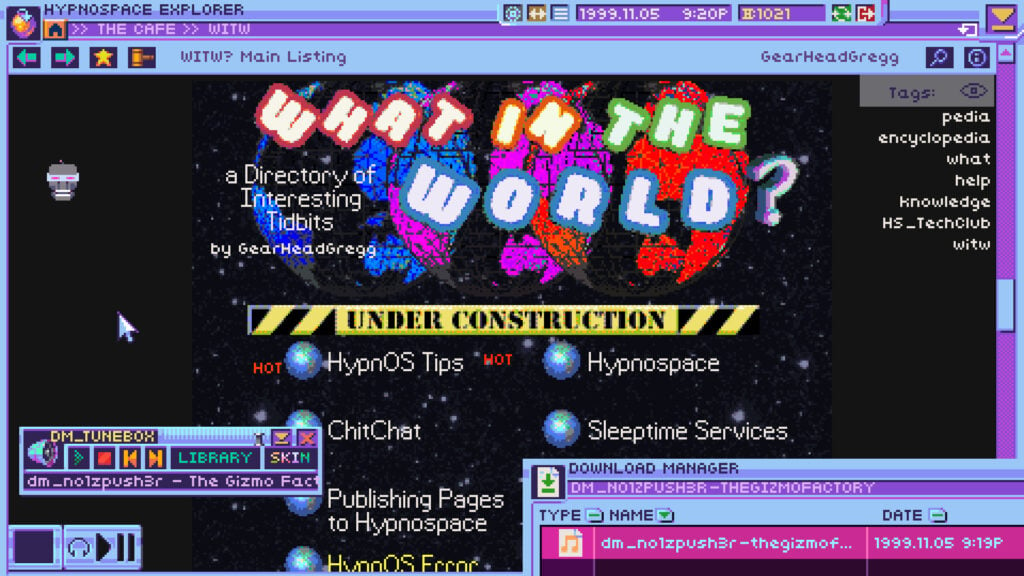
Looking for something sort of like The Roottrees Are Dead? Hypnospace Outlaw might be it. It predates Roottrees by a few years, having seen its initial release in 2019, but it’s set during the same era (the late ‘90s) and, as such, utilizes a similar version of the internet. (Young’uns, yes, this is what the internet used to look — and sound — like. Also, we capitalized Internet back then, and frequently referred to it as the World Wide Web. How quaint!)
Although the gameplay is somewhat similar, though, with players essentially digging as far down into the depths of the internet as they can while attempting to solve certain mysteries, those mysteries themselves are quite different. Hypnospace Outlaw, you see, is set in an alternate version of the year 1999 — and in this alternate timeline, people can browse the internet while asleep.
The internet in question is Hypnospace, and the equipment required to browse it include a special headset running a specific operating program, HypnOS — all of which are, of course, created and own by a private company, Merchantsoft. And, of course, the Hypnospace community also requires moderation, which is where you come in: You’ve taken a job as an Enforcer, making you the person who hunts for things like copyright violations and other unacceptable uses of Hypnospace and reports them, with the goal of getting them removed.
Trouble is, something else is going on in Hypnospace — something that’s killing people in real space….
There’s a reason Hypnospace Outlaw has become basically the poster child for this particular brand of game — the kind that takes place entirely within a computer — and it’s an incredible achievement that’s riveting all the way through.
Available on Steam, Xbox, PlayStation, and Nintendo Switch.
15. Type Help
The title of the game Type Help is the very first thing you’ll do when you start playing it: You’ll type “help” into the input field. Because that’s all there is to this game, in terms of its actual gameplay; you type stuff in, and see what comes up. The rest of it, though? That’ll have to happen in your own brain — or maybe on a notepad. There’s a lot to keep track of here, and the mystery you’ll be trying to solve is a big ‘un.
That mystery is about what happened at Galley House on the seventh of March, 1936. That day, a group of people journeyed up to the house, which was believed to have been long since abandoned, and found the remains of… quite a few people. It wasn’t clear how they died, or why, and the case was never solved.
Now, you’re in possession of the ‘90s-era computer of someone who was reinvestigating the case — someone who is also… no longer with us. It’s fallen upon you to dig through the files on the computer, no matter how deeply they’ve been buried, to see if you figure out what happened — at Galley House, and to the investigator decades later.
If you love and miss text-based games, and/or browser games, this one is both, though there’s a remaster on the way that looks as if it’s going to take things out of the computer interface and into a more standard first-person view. That one will be called The Incident At Galley House, though if you want to experience the story in its original and, I would argue, more unique form, is playable for free over at Itch.io.
Available on Itch.io.
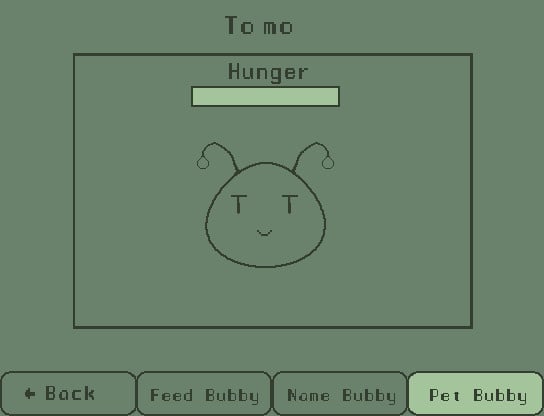
16. Bubbaruka!
Note: If content warnings are useful for you, you might want to look them up for this one; underneath its charmingly retro surface, there’s a lot of darkness.
The setup for Bubbaruka! is a pretty classic one: Many years ago, there was a toy that was in development that seemed like it was going to be an absolute smash hit — but then, development abruptly ceased and the toy was never released. It subsequently fell into obscurity… until now: You’ve acquired the toy in some way, shape, or form, and as you begin exploring what you’ve found, you begin to unearth the real reason the toy was never released — and it is quite dark, indeed.
With Bubbaruka!, that toy is the titular Bubbaruka — a Tamagotchi-like virtual pet. You’ve acquired not the full toy — we’re not talking about a little plastic egg here — but the files that would have made the toy run. And those files? Well, if you’re not careful… you’ll not only find out why Bubbaruka was never released, but you might fall prey to the thing that was its downfall yourself.
This one looks like a virtual pet, but plays like a survival horror game, so bear that in mind if you’re not a fan of, say, constantly needing to flee surprise monsters. But if you’re a fan of games like Ao Oni, and if you have a certain nostalgia for the Tamagotchi, Bubbaruka! might be up your proverbial alley.
Available on Steam.
17. The Operator
Welcome to your new job! As an Operator here at the Federal Department of Intelligence, your work is of the utmost importance. You’ll spend your days assisting field agents right here from your very own computer, analyzing evidence, conducting lab work, and checking the facts. Our agents can only be as effective as the help you give them. You are, as they say, the person in the chair.
Should you be contacted by any outside entities — personnel who are not part of the FDI, and who have no business examining the agency and our work — well, that might… complicate things for you, mightn’t it? You wouldn’t want to be caught conversing them, would you? Working with them? That might be… hazardous to your health.
With all of the conspiracies at play within the mysteries you’ll unravel as you go, The Operator feels like The X-Files minus the aliens. It’s worth noting that some have found the ending to be a bit of a cliffhanger; if that idea bothers you, then you may want to steer clear. However, The Operator 2 is currently in development, so there’s hope that some of those unresolved threads might see some tying up eventually — and maybe in a way that gets at something much bigger than the sum of its parts.
Available on Steam and Nintendo Switch.
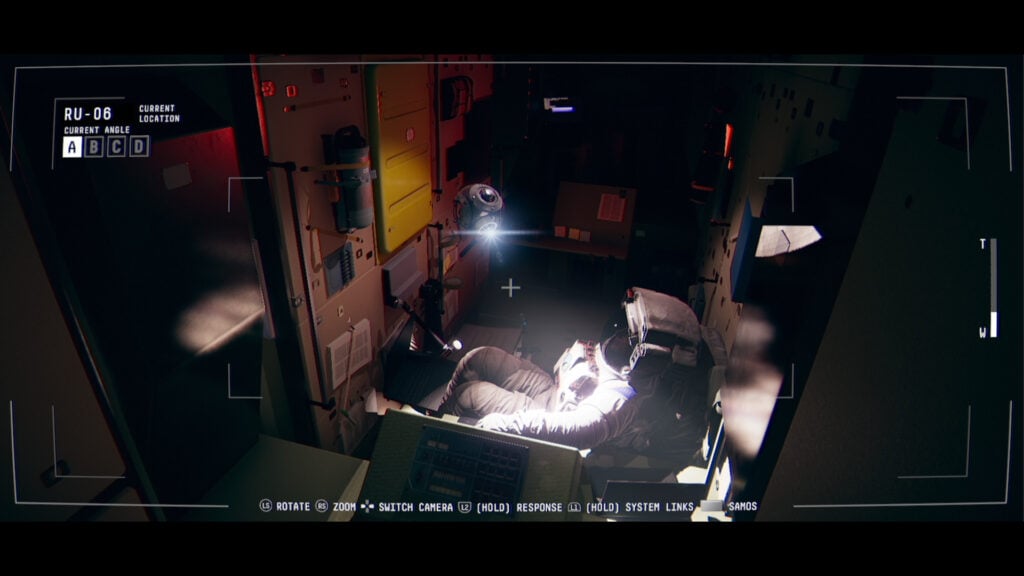
18. Observation
Like a couple of the other games on this list, Observation ticks the sci-fi and horror boxes (and also the mystery/detective one, along with a couple of others) — but unlike in, say, Duskers, you’re not controlling the ship. This time, you are the ship.
Or at least, you’re the program that runs the ship. You are SAM — Systems Administrator and Management — for the mostly-abandoned space station Observation, on which Dr. Emma Fisher appears to be stuck as the lone remaining occupant. What happened to everyone else? And is the station really abandoned, or is there… something else on board with Dr. Fisher?
It’s your job to work with Dr. Fisher to help her figure out what the heck happened and what to do now. How, you ask? By, well, doing what you’re meant to do: By administering and managing the systems of the space station. That might mean opening doors, operating cameras and viewing camera feeds… you name it.
But technology isn’t foolproof, and it’s not omniscient. There’s… more going on here than either or Dr. Fisher know, and things get weird, fast.
Observation comes to us from the same developer as Stories Untold, so expect unconventional gameplay and a lot of twists and turns. If you dig the movie Event Horizon, you might think about giving Observation a shot.
Available on Steam, Xbox, and PlayStation.
19. Project DeepWeb
Note: If content warnings are useful for you, you’ll want to look them up for this one. As you might expect for a game that takes place primarily on the Deep Web, there’s… a lot of heavy, gross stuff in here.
Here’s the deal: Your friend is missing. The key to finding them might be hiding somewhere on the internet. But not the surface-level internet — you’re going to have to go deeper than that. Down into the darkest corners of the Deep Web, to somewhere known only as the Silent House. There, you might find the information you’re looking for… as long as you don’t mind that what you might learn while you’re down there is the kind of thing you can never unknow again.
Uncover websites and files; solve puzzles and dig deeper.
Save your friend… hopefully.
From a gameplay perspective, Project DeepWeb is cut from the same cloth as Hypnospace Outlaw and The Roottrees Are Dead; however, we’re not looking at ‘90s-era internet here — we’re looking at a slick, modern day interface that’s a lot easier on the eyes. It’s perhaps less inherently unsettling in that respect (there’s something about nostalgia that carries with it a specific flavor of horror), but it’s eerie in a different way. It’s smooth and faceless; its eeriness is in its unknowability.
A spinoff is on the way, so if you like the OG Project DeepWeb, look out for Project DeepWeb: Eternal Nightmare in the hopefully not too distant future.
Available on Steam.
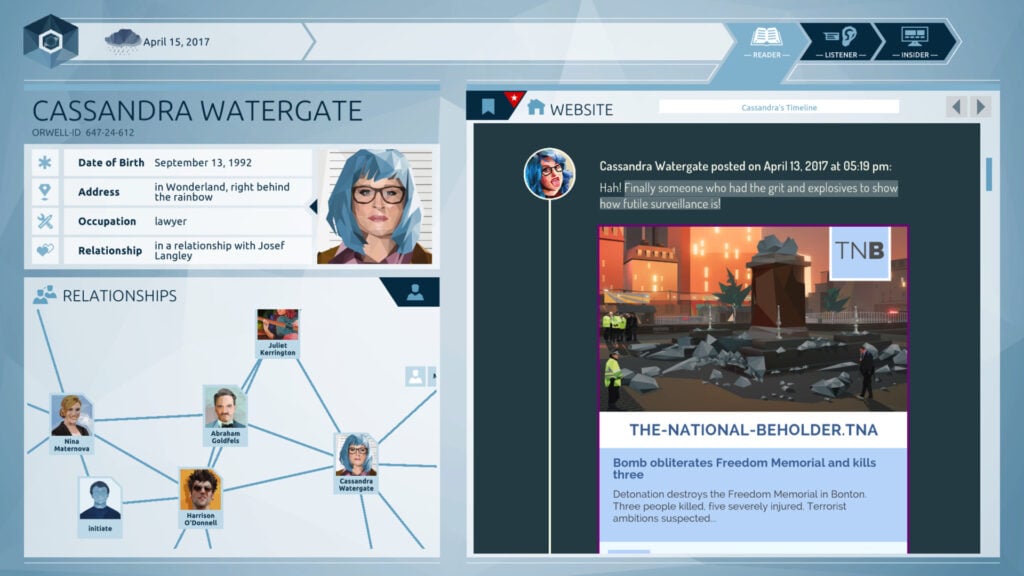
20 – 21. The Orwell Series
There’s something about stories with themes of fascism that lend themselves so well to this format, so it should be no surprise that a series titled Orwell falls under the games-set-within-a-computer-interface umbrella.
Positioned as two parts of a single story — two seasons of a television show, sort of — Orwell: Keeping An Eye On You and Orwell: Ignorance Is Strength both take place in The Nation, run by a government known as The Party. Prior to the events of the games, a bill was passed that functionally allowed the government unlimited powers of surveillance upon The Nation’s population, with that surveillance being facilitated by a system called — you guessed it — Orwell.
And you? The player? You’re an Orwell investigator. It’s your job to conduct all that surveillance. You are Big Brother.
And that means you have some choices to make about how you handle yourself and your work, doesn’t it?
One of the things that sets Orwell apart is its art style. In a break from the common choice for games of this type, it’s not intended to look photorealistic; the details are much more stylized. SO while all the actual interface stuff looks familiar and realistic, images within the interface—profile pictures, photographs in social media posts, video feeds, and so on — are quite a bit less so. It’s more of a cell-shaded style, or almost mosaic-like; it’s weirdly beautiful to look at, which makes the contrast between what you’re seeing and what you’re doing all the greater.
The Orwell games were originally released in 2016 and 2018 — and although the rise in authoritarianism was definitely already in motion then… well, let’s just say that they hit very differently today.
Available on Steam.
22. Lost Wiki: Kozlovka
A good ol’ fashioned “something is wrong in this town and you have to figure it out” game, Lost Wiki: Kozlovka puts you in the shoes of a journalist with access to a Wikipedia-like database. Your job, naturally, is to crack the case about what the heck is going on in the small Eastern European town of Kozlovka via what appear to be Golden Idol-style fill-in-the-blank puzzles. If you love falling into Wikipedia rabbit holes, this game is basically being tailor-made for you.
Available on Steam.
Honorable Mentions And Upcoming:
This category encompasses our “plus a few more” caveat. They either don’t quite fit the theme, or they haven’t been released yet, but look to be worth keeping an eye on. Think of them as little bonuses to the main list.

Honorable Mentions:
First, our honorable mentions: Games that sort of feel like they should be included here, but which don’t quite actually have the UI-style gameplay that I’m looking for. But they’ve got the right vibes, if nothing else, and I think they’re worth looking at.
1. Who’s Lila?
Note: If content warnings are useful for you, you’ll want to look them up for this one before you play.
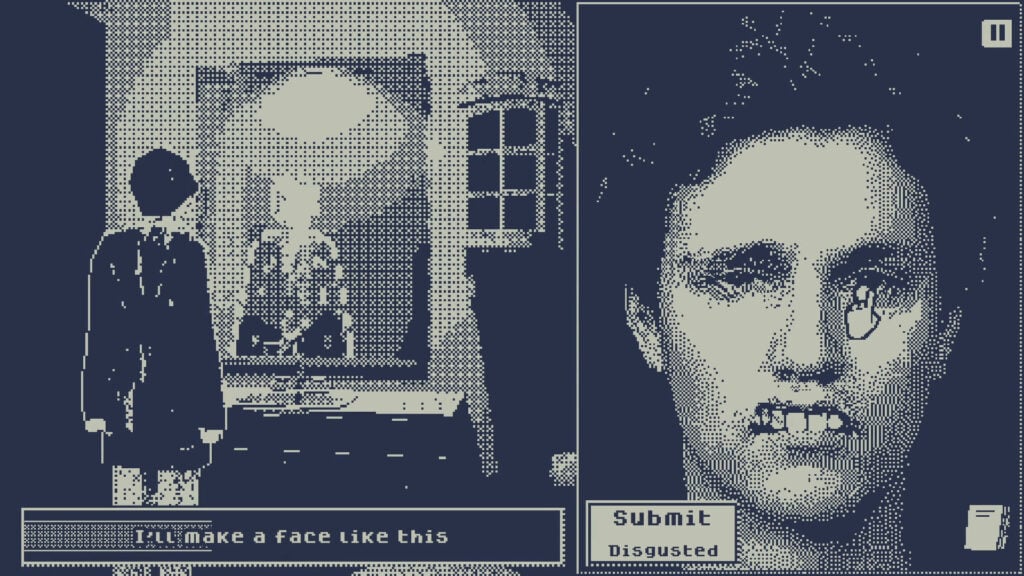
In Who’s Lila?, you play as William Clarke, an 18-year-old who doesn’t experience emotions quite like other people do. Or… at all. As such, he has to think really hard about how to manipulate his own muscles and features to arrange his face into the appropriate expression when speaking with other people.
This is all the more important when William winds up involved in a missing persons case; if he doesn’t arrange his face — if you don’t arrange your face — in socially acceptable was under certain circumstances, William might be accused of having something to do with it.
This doesn’t necessarily mean you don’t have something to do with it, by the way.
Who’s Lila? doesn’t actually take place within a computer interface; it just has that retro-style look to it. But even so, though, the gameplay does feel somehow adjacent to it: It’s display as a split screen, with what’s going on in the world on the left and William’s face on the right. You have click things and move things on Williams’ literal face to arrange it into the appropriate expressions during each encounter he has. It’s tactile in the same way that, say, games where you’re typing commands as if you’re hacking into a mainframe or what have you are. You’re just manipulating a human face instead of computer files.
Available on Steam.
2. Aberration Analyst
Like Who’s Lila?, Aberration Analyst has a retro look to it, but although it sometimes does include computer-within-a-computer screens, it doesn’t really take place within a computer-type interface quite enough for it to go in the main list.
That said, there’s a lot here that will probably appeal to those looking for a set-within-a-computer-UI game. You are, as the title might imply, an aberration analyst — someone who analyzes information to locate supernatural threats, then and dispatches teams to neutralize the threats. You’ll have to look through all sorts of source, both digital and analog, for clues; when you think you have enough to go on, choose your team and send them into the field.
Just… choose wisely. You do want them to come back alive, after all.
Available on Steam.
Upcoming:
Next, UI-like games that haven’t been released yet, but which look promising.
1. Shutter Story
Shutter Story sounds a like Lake-Mungo-but-make-it-a-video-game: Your best friend thinks his family is being haunted, and he thinks the evidence is in the photographs he’s been taking. Your job — as a supportive pal, of course — is to analyze the images your friend provides and try to show exactly what’s going on in his home, to his family.
Inspirations for this one include Her Story, Home Safety Hotline, and Mouthwashing, along with the 2001 Kiyoshi Kurosawa film Kairo, also known as Pulse — all excellent works. It’s aiming for a Q3 release in 2026; I look forward to seeing how it all shakes out.
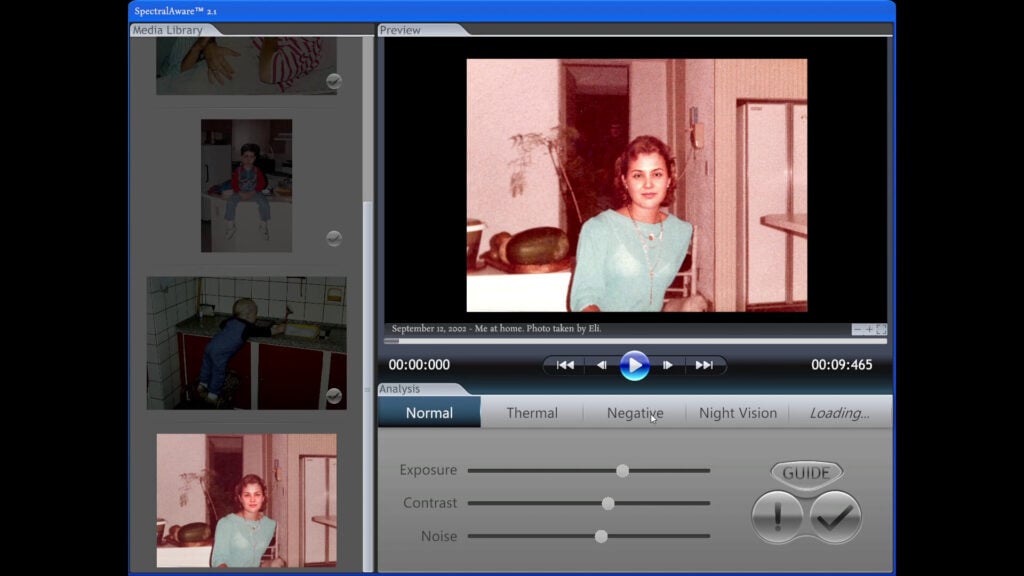
2. Lily’s World
Lily’s World follows the Simulacra formula: You’ve somehow acquired a piece of technology — in this case, a laptop — belonging to someone else, and as you dig through the files on it, things get weird. The laptop in question here belongs to the titular Lily, and it’s an early-2000s teenage dream, full of glitter and GIFs and AIM profiles. But there’s something… not right going on.
And eventually, someone — someone who somehow knows you have this laptop — knows that you’re not Lily.
And that, it seems… is a problem.
This one is made by a solo dev, Sondering Emily, who guarantees “authentic cringe”; per the Lily’s World website, all of the photographs contained within the game are either hers or her friends’ from their own teenage years.
No release date yet, but as of September 2025, Lily’s World has found a publisher, so hoorah for that!
3. My Little Friend Chibi
I know almost nothing about My Little Friend Chibi other than the fact that it appears to be another Tamagotchi-inspired game with a deep, dark secret. Nothing else is available about it, including a release date. Looks promising, though! Love a good weird virtual pet game!
All right, friends. Hopefully that’s enough to keep you busy for a while. Happy gaming — just… be careful.
You never know what you might find in someone else’s computer, after all, right?
***
Follow The Ghost In My Machine on Bluesky @GhostMachine13.bsky.social, Twitter @GhostMachine13, and Facebook @TheGhostInMyMachine. And for more games, don’t forget to check out Dangerous Games To Play In The Dark, available now from Chronicle Books!
[Photos via Blake Connally/Unsplash; Evil Trout Inc., Not a Sailor Studios, No Code, Daniel Mullins Games, Misfits Attic,
Tendershoot/Michael Lasch/ThatWhichIs Media, Benjamin Schade, No Code, Osmotic Studios, Garage Heathen, Frostwood Interactive/Steam; markusspiske/Pixabay]
Leave a Reply