Previously: “Username 666” And PiroPito’s Bizarro-Land YouTube Universe.
Think back to your high school days (or think about your school now, if you’re currently in high school). Were there any… weird stories that circulated about your school? Stories about haunted classrooms, superstitions about why you don’t go to a certain sports field at night, that kind of thing? What about… rumors? Rumors about disused areas of the school? Places that have been closed up, covered up, hidden from view and erased from both the memory of the school and its physical footprint? Because that’s what’s going on in the web series School Rumors — but as a series of ill-fated students make their way into the disused basement of a private high school in Massachusetts over the course of the series, it becomes very, very clear that there’s more happening here than just rumors.
Created by Beckett Wagner and filmed at his own high school, School Rumors comprises eight videos uploaded between Oct. 3, 2022 and Jan. 8, 2025, plus a bonus behind-the-scenes video that went live on Jan. 26, a few weeks after the conclusion of the series. It’s not long; that’s one of the things I like about it — at about 90 minutes total not including the behind-the-scenes video, it’s nice and self-contained, and roughly my ideal movie length. It’s also not a particularly complicated production, being quite literally a one-man show — but in many ways, that makes it even more impressive.
[Like what you read? Check out Dangerous Games To Play In The Dark, available from Chronicle Books now!]
In addition to being quite an accomplishment for a high school student to have made — especially as a solo venture — School Rumors hearkens back to the good ol’ days of the found footage web series. I love that, and I think it’s worth talking about why it’s so effective, particular in our current, typically quite high-tech web series landscape.
The basic story is this:
Sometime in the 1990s, a private high school in Massachusetts sealed off the basement of one of its buildings. The unused basement was subsequently forgotten about, although for a time, it hid in plain sight — visible if you knew to look for it, although during this period, no one did.
As the years passed, however, the abandoned basement moved from forgotten history to curious legend, and students began to speak of it again, passing around whispered stories of an unused floor in one particular building that was closed up for unknown reasons. Or, even if they didn’t know about the basement itself, they spotted things that made them wonder: Buttons in elevators that went nowhere, or elevators that simply weren’t in use anymore at all.
Most only wondered, but over the next several decades, a series of clever, resourceful, and — regretfully — foolish students did more than wondered: They searched. Each discovered a way into the basement, and attempted to explore and document what they found there, with the help first of digital cameras, and later of smartphones equipped with recording features and functions.
None of them were ever heard from again — until 2022. Until now. Until the footage from all of their cameras was found and made public.
And that’s where we, the audience, come in. We don’t know who found the footage, or how they acquired it — not at first, at least — but we’re here, and we have a role to play, too, as we bear witness to what happened to all of the missing students.
What makes School Rumors work so well, I think, is actually quite simple. As the series progresses — as each student explores, and subsequently vanishes into, the hidden basement — more pieces are added to the puzzle, although never so many that it paints an overly detailed picture. And that is where the series’ main strength lies: School Rumors is a lesson in how, in storytelling, sometimes less is more.
I talk about the less-is-more principle a lot here at TGIMM, largely because it’s a particularly strong way to tell a story. If a story doesn’t reveal every last detail about itself to us, we have to engage with it much more deeply — we have to look at the pieces we’re given and figure out for ourselves what we think it all means, or what the bigger picture is. And that, in turn, makes the story that much more personal for each person who engages with it — what we bring to the table can affect what we get out of the story itself, sometimes in some extremely dramatic ways.
School Rumors demonstrates the less-is-more principle in three primary ways:
The first is in the way the series handles the flow of information: It doles out new information bit by bit, which what’s revealed in each video building on the last one only slightly, but always in meaningful ways. We always walk away from a new installment knowing something new about the situation, the monster, the location, or the overall story — but never too much at once. It’s always just enough to move things along.
Second, it doesn’t overexplain any of this information or any of the details. It doesn’t provide all the answers, or even that many answers in the first place. It knows that overexplaining everything and providing answers to every single question the series raises would make it much less effective as piece of storytelling. And it also knows that what we don’t see is far, far scarier than what we do see.
And third, it uses practical effects — often deceptively simple ones — to great effect. The payoff is enormous, and a testament to the fact that technology isn’t everything — and, indeed, is often best used sparingly. I’ve commented a few times that we should never underestimate what talented — and, I’ll add, creative — teenagers can do with the right tools; and it’s worth remembering that sometimes, “the right tools” are just old, second-hand cameras and access to a hardware store. Here, the monster in the basement looks real, because it is real.
So: Let’s take a look at the series through that lens, shall we?
Let’s investigate some school rumors.
If we’re lucky, we’ll solve the mystery.
And if not?
Well… let’s just hope we survive the experience.
Notes From A New England Boarding School: On School Rumors’ Setting
Before we get into the meat of the series, there are some things you should know about its setting. School Rumors is set at a private high school in New England (Massachusetts, specifically) with a boarding program — presumably the school Beckett himself attends in real life. And private high schools in New England that are either partially or entirely boarding schools work in some… highly specific ways.
There’s a lot about this setting that I recognize myself. Why? Because, like Beckett, I also attended a private high school in New England with a boarding program. Granted, my time there was… quite some time ago, because I am an Old; as such, my experience almost certainly differs from Beckett’s, likely in some fairly major ways. Still, though: Little references and comments made by the various point-of-view characters throughout the series rang very, very true to me, even with the space of so many years between my own school days and Beckett’s.
I would be remiss if I didn’t acknowledge how immensely privileged I was to have attended such a school — although truthfully, if I had to go back in time to my teen years, would I do it again? Absolutely not! And for a wide variety of reasons, at that! But, it is what it is; and, as such, I do have the experience to speak somewhat knowledgeably about what these kinds of schools are like. So, here we are.

I should note, too, that I don’t know which school in particular Beckett attends (and I wouldn’t identify it even if I did — I am generally not in the practice of randomly doxing people, especially not teenagers); all I know is that, judging from its appearance, it’s not the one I attended. As a result, yes, I am generalizing a bit here. These kinds of institutions do all tend to operate fairly similarly, though, so if you’re not familiar with the way schools like this are inclined to function, here’s the rundown.
First, let’s talk campus: The physical and geographical layout of your average New England private high school — like the whole experience of attending one, really — is often more like what you’d find at a college or university than what you might think of as a typical high school. Rather than one large building, a school of this type often consists of a number of smaller buildings spread out across a fairly sizeable campus, with each building housing specific departments or areas of study.
You might, for instance, have one building that houses the math and science departments; you might have one for English and history; you might have one for visual and/or performing arts; you might have an athletics center, with a gym, locker rooms, and, potentially other facilities — think wrestling rooms, dance or yoga studios, a pool, the infirmary, etc. — depending on the school; and so on and so forth. The buildings may or may not be connected in some way; if they are, those connections can be either above ground (covered walkways, weird hallways extensions, things like that) or below (tunnels).
Although the first video in the series identifies it as possibly taking place “under the STEM building,” School Rumors seems, according to later videos, to take place in or under the arts building — in this case, possibly one that houses both the visual and performing arts programs, as evinced both by what we see in the footage and what we hear our various point-of-view characters talking about throughout the course of the series. We see, for instance, a few art classrooms, as well as buttons for floors on both of the elevators labeled with “Visual Arts” — but then, we also see an auditorium a couple of times; we hear a few of our ill-fated protagonists mention the music department being housed “upstairs”; and it’s pretty clear that the abandoned classrooms we see in the basement itself used to be music rooms. Ergo: We’re probably in some sort of visual and performing arts building.
Next, daily life: Even at schools with a student population split between boarding and day students, the everyday schedule of this kind of school is usually designed around the boarding students — the assumption is that everyone will basically be at school all the time, not just during the portion of the day taken up by classes. As such, classes will typically take place from morning until the early or mid-afternoon — nothing unusual there — but after that, your day is far from over. Athletics, which may be required, rather than optional (if they’re required, they take the place of a more standard “gym class”), generally happen after classes are over; so, too, do rehearsals for many of the performing arts programs, some of which might not even start until after the dinner hour and could go as late as 10pm. Other extra curriculars that may be school sanctioned, though not school run, also often take place in the afternoon or evening — think clubs, student-run organizations, that kind of thing.
Because of the all-day style of scheduling, there tend to be a lot of common areas and hang-out spaces on campus. This is both so boarding students and day students can mingle (gotta make sure your student body is cohesive), and also so that the day students, who don’t typically have access to the dorms, have somewhere to go if they’re, say, done with classes for the day, but still have a few hours before their next activity. The cafeteria also serves three meals a day, which both boarding and day students can access. (If everyone is on campus all the time, gotta make sure they’re fed.)

If you’re a boarding student, you may or may not have unsupervised freedom of movement beyond campus during the day; it varies by school. At night, however, you’ll pretty much always have a dorm check-in time — a curfew by which you’re required to be physically present in your dorm, not to leave again until morning. (Although private boarding high schools do have a lot in common with the university experience, one of the big differences is that high school students are still minors and therefore legally require much more supervision than university students.) In my day, check-in usually involved signing yourself off on a piece of paper to confirm you were there, or actually stopping by your dorm parent’s apartment so they could lay eyes on you and check you off on the list themselves. These days, I’d be willing to bet there are higher-tech systems in place — tablet-based sign-in sheets instead of paper ones, stuff like that — but the idea is fundamentally the same.
It is a big deal to miss check-in. You don’t get that many chances to fuck up at schools like this; usually there’s something like a three-strikes system for all major infractions, which missing check-in can be considered, and after your third strike, you’re facing expulsion. So, if you notice that several of School Rumors’ POV characters seem especially nervous about missing check-in — which starts at around 10:30pm in the first video, according to its POV character, though becomes earlier and earlier as the series goes on — that’s why.
All of this is to say: We’re dealing with a highly specific setting here — one which, I should note, also a real-life explanation for why it took more than two years for all of School Rumors to be uploaded. Given the circumstances under which the footage is acquired within the story, you’d think the in-universe finder of the footage would want to upload it all as soon as possible, right? But here’s the thing: Assuming the real-life Beckett is, in fact, a student at the school he shot at, he would only have access to campus during the school year. And it’s not even just a matter of school being in session or not; it also has to do with Beckett’s relative distance from campus: Depending on where he’s actually from, he could be anywhere from a few towns over to literally on the other side of the country during summer break.
Between students generally not being permitted on campus between the end of spring term and the beginning of fall term, and the possibility that Beckett may not even be anywhere near campus for June, July, and most or all of August… well, you can see how that might stretch out production pretty considerably, especially given the one-man show nature of the whole thing. Sure, he could edit away from campus, but he would only be able to shoot during term time. Hence, the series requiring a little more than two years to create, from its initial start to its final upload.
In any event, this setting is one of the things that makes School Rumors unique, and explains some of the quirks of the way it works as a piece of storytelling.
So with all that out of the way, let’s dive in, shall we?
Knowledge Is Power: School Rumors And The Flow Of Information
Each video in School Rumors follows more or less the same plot structure: A student finds their way into the disused basement; they do some careful exploration; they encounter the creature living down there; and, eventually, the creature catches them. As such, I won’t go story beat by story beat here, as the plot points for each video all tend to be more or less the same — and again, the whole series is only about an hour and a half total, so I’d urge you just to go watch the dang thing in its entirety for that.
Because here’s the thing: Even if the plots tend to repeat, what sets each video apart from the ones that came before them is the ways in which they each build on what their predecessors laid down. That’s what I’m interested in, so that’s what we’ll talk about here.
At more than 18 minutes in length, the first video, titled “Found in the long-unused basement of a Massachusetts high school” and uploaded on Oct. 3, 2022, is by far the longest. This is for a few reasons, one of which is that, as Beckett later explains in his behind-the-scenes video, it wasn’t a planned project at all at that point: He had simply found a way into the basement of one of his school’s buildings with a recently-acquired second-hand camera, and while he was down there, he began imagining a “what if?” scenario that he decided to play out and record as he went.
The other reason for its relative length, I would argue, is that this first video sets the conventions and rules for what Beckett would eventually decide to turn into a series. As our POV character — John, the narration tells us as the video progresses, a 16-year-old student at the then-unnamed private high school in Massachusetts — moves through the basement, the footage establishes all of the following:
That the school has a closed-up, long-disused basement; that the basement is accessible by elevator; the location and appearance of at least one such elevator (one on a stairwell landing, which I’ll call Elevator 1); the overall map and layout of the basement, including old classrooms, junk lining the halls, and numerous locked doors; that the stairwells leading out of the basement are not accessible; that doors can close and lock on you while you’re down there, even if you initially opened them with ease; that the elevator will not function if you try to use it to return to the building’s upper floors; and that there is something — something — living down there. Something aggressive and hostile. Something to be avoided at all costs.
The second video, titled “Security Flaws” and uploaded on April 13, 2023, builds on the previous video in only a few ways — but the information on offer is essential moving forwards:
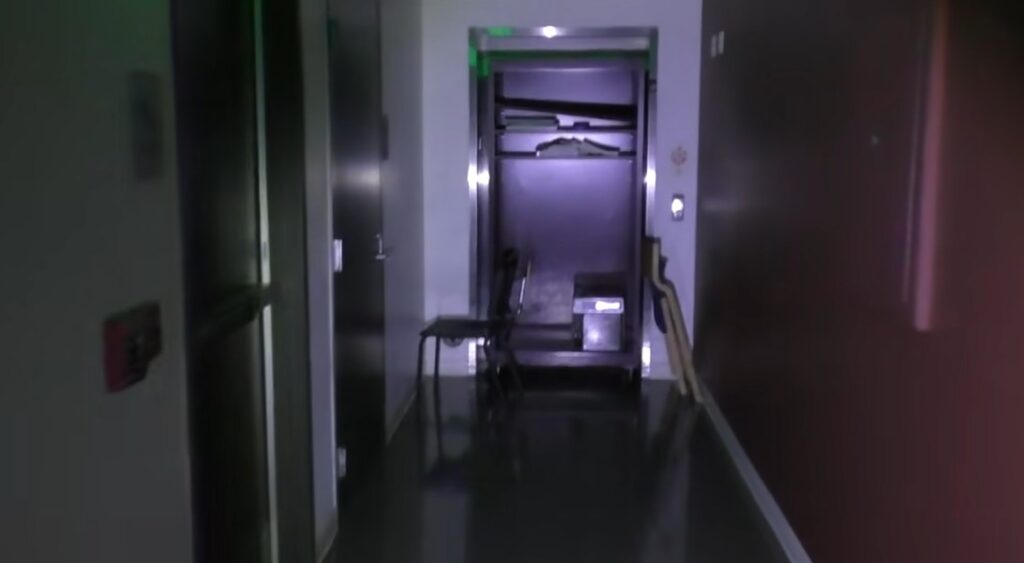
- It establishes the presence of a second elevator that can be used to access the basement (one in a disused hallway in the art wing, which I’ll call Elevator 2);
- It establishes that time has passed, as evinced by the fact that fewer lights are working in the basement; we also learn a little bit more about the precise time period we’re in: Our POV character finds a computer with a Windows XP logo on it and calls it a “dinosaur.” (For the curious, Windows XP was in use beginning in 2001, and was succeeded by Windows Vista in 2007.);
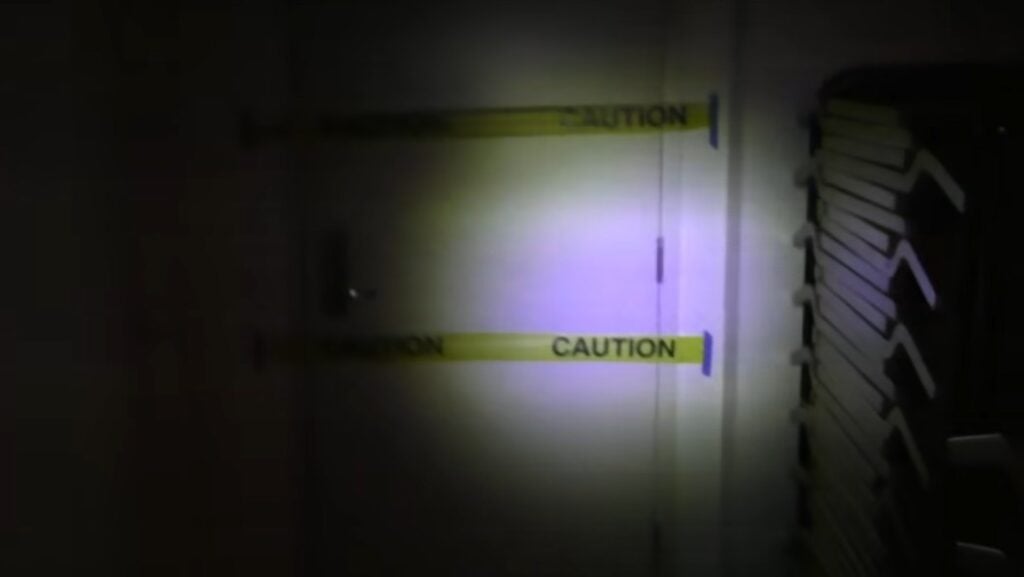
- And crucially, it establishes that the school knows about the danger, and that it is actively covering up the situation: Caution tape has been used to block the door leading to the area where John disappeared, a draft of a “basement shutdown notice” is present, and Elevator 2 has had the power to it cut and its basement floor button taped over with blue painter’s tape.

Additionally, it becomes less ambiguous that the creature in the basement attacks and causes physical harm to those who encounter it, as evinced by the sound cues in the last few seconds and the final shot of our unnamed POV character’s bloody limb.
Video the Third, “A student explores his high school basement,” was posted on May 25, 2023. It also establishes comparatively little when held up against the previous videos, though what it does establish remains important:
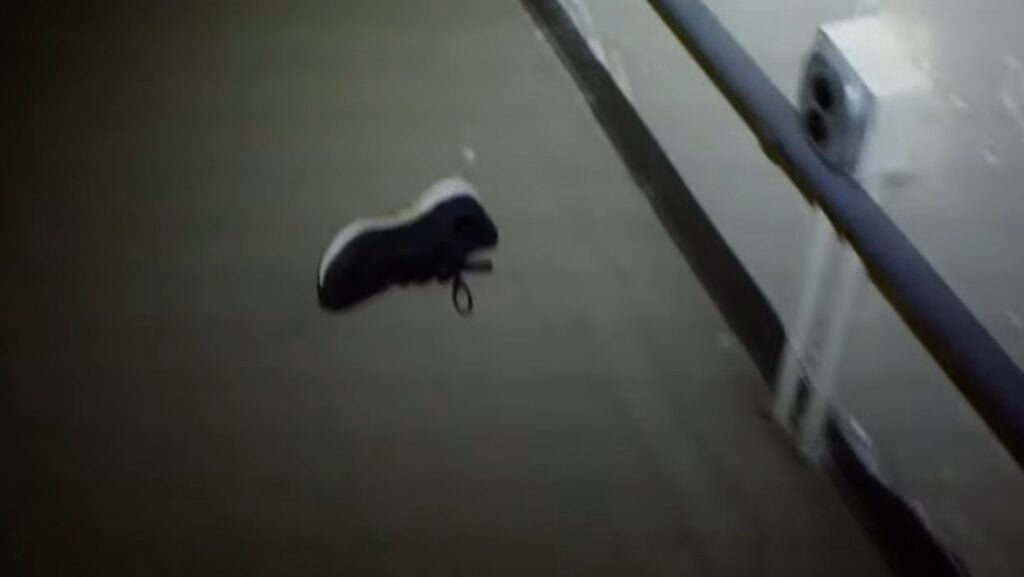
First, more time has passed: Elevator 1 now has an “out of order sign” on it, and apparently has for years; the power to it has also been cut. And, unsettlingly, our (again unnamed) POV character finds a random shoe in one of the basement hallways — presumably a shoe belonging to the previous student to have disappeared. This shoe will subsequently show up in every video after this. Also worth noting is that after this character pulls the fire alarm (only to find, of course, that nothing happens when he does so), all other subsequent POV characters will spot the pulled fire alarm in every video to come.
Additionally, our narrator tells us that dorm check-in time is now roughly 7:30pm, which is much earlier than it was in the first video (“John” had previously worried at 10:15pm that “in 15 minutes” he would be “written up for being late” for check-in). This might be indicative of further attempts by the school to control the narrative: If the two missing students disappeared late in the evening, shifting dorm check-in time to an unreasonably early hour might be an attempt to halt further disappearances.
We learn a little more about the school’s programs and facilities. The music department — which seems to have once been based in the abandoned basement — is now upstairs, and the fire alarm in the basement doesn’t seem to be connected to anything anymore.
Lastly, if we listen carefully, we learn that the creature causes audio distortion in the footage’s sound when it’s nearby.

The fourth video went live on Oct. 3, 2023. Titled “Going Off the Beaten Path,” it again has relatively few developments, but the two biggest ones are firsts for the series:
It again establishes the passing of time — but this time, it does so in its use of technology: The POV character has a flip phone here. This is notable both for being the first time we’ve seen or heard mention of a cell phone in the series, and for giving us an identifiable era in which the video is set. I’d place it probably in the mid-to-late 2000s, give or take a few years. (The iPhone, which is usually credited with leading the popular charge on smartphones, debuted in 2007, so we could be either a few years before or a few years after that here.)
And second, we learn more about the physical form of the basement inhabitant: We catch our first glimpse of the creature’s tendrils climbing on the wall here.
The fifth video, posted on Feb. 9. 2024 and titled “Student Disappearances,” ups the ante in a number of major ways:
In terms of time, we are now well into the internet age, as per the POV character’s comment about learning how to pick locks with a paperclip via the internet. I’d even take it a step further and say it’s probable he would have learned from YouTube, which would put us at least in the late 2000s (YouTube debuted in beta form in 2005 before being purchased by Google in 2006; after that is when it really started to take off as a platform), but more likely in the 2010s.
We also learn more details about the school, the basement, and the coverup: This POV character knows about the basement rumors and the missing students; he knows the official story that plumbing and electrical issues and the expense of repairing them reportedly caused the school to close off the basement; and he finds paperwork for a water shutoff warning naming the school itself: Stony Brook High School. (This is almost certainly a fictional name, by the way, but it’s worth noting for the purposes of the in-universe setting.)
And, we learn that, should you try to escape the basement through an alternate means outside the elevators, like a vent, the creature can and will follow you in and catch you.

Video the Sixth is titled “Growth and Movement” — and, when it’s uploaded on June 4, 2024, it does, in fact, give us both growth and movement.
For one thing, it expands the map and layout of the basement. And it does so in a few ways:
- First, it builds on a suggestion brought up by the previous video: If there are other ways out of the basement, like a vent, are there other ways in? The answer is yes: Neither elevator is used for initial access in this video. Instead, our POV character gets into the basement through a hatch in a closet, after which he drops through the ceiling into the basement itself.
- This, in turn, lets us see a new area of the basement. When our POV character lands, he passes through a door that puts him in the area with the caution taped door. The door he uses here was previously locked in all of the other videos; we’ve never been able to see what was on the other side of it before.
Dorm check-in is now 7pm, by the way, which is extremely early. Again, I wonder if this is indicative of the school trying to maintain even the smallest bit of control over the situation.
And lastly, the tendrils are now bigger, more expansive, extending over a larger surface area. The creature is growing — maybe with each student it catches.
The last two videos — “Message Received,” posted on Oct. 10, 2024, and “Emergency Exit” (note that there’s a strobe light warning for “Emergency Exit!” Watch with care if you’ve got photosensitivities),uploaded on Jan. 8, 2025 — work in tandem; they follow one after the other, with the protagonist of “Message Received,” Brodie, communicating via text directly with the in-universe version of Beckett himself, who then becomes the POV character for “Emergency Exit.” In both of these videos, we’re in the modern day — although by “modern day,” we’re probably looking at 2022 within the reality of the story, despite production likely having happened in 2024 (we’ll talk about why that is in a minute!) — and everything about the story comes into focus:
In “Message Received,” Brodie is able to summarize the evolution of the school basement rumors over the years more concisely than any of the other protagonists have so far: He says the basement was sealed 30 years ago; he notes that the school is failing due to the rash of student disappearances over the previous decades and likely to close within the next few years; and his plan is to go into the basement and see what he can record in an attempt to bring closure both to the families who lost their kids, and to the whole saga in general.
The creature, notably, is at its most aggressive in this video, with the audio distortion and tendrils appearing much sooner than they do in any of the other videos.

“Emergency Exit,” meanwhile, primarily accomplishes two key things: It offers an interesting suggestion about the true nature of the creature, and it answers the only questions in the series I would argue absolutely need to be answered — namely, who, exactly, is uploading the footage to YouTube and how they got a hold of it in the first place.
With regards to the creature, the tendrils actually attack Beckett — and in the aftermath of this attack, we see a tendril poking out of the back of his hand, which he then has to (ick) pull out of himself. To me, this suggests either that the creature is a parasite — that it was trying to work its way into its next human host — or that it essentially took over, absorbed, or otherwise consumed the other missing students, possibly explaining how it’s grown so large over the previous three decades.
And as for who’s uploading the footage and how they got it? It’s the in-universe version of Beckett himself, who we now know to be another student at the school, and he acquired the footage over the course of “Emergency Exit”: After Brodie goes silent, Beckett ventures into the basement after him — and when he arrives, he finds all of the cameras from the previous protagonists. Smart kid that he is, he pops out the memory cards from all of them, rather than trying to grab the cameras themselves, and pockets them.
At this point, we, the audience, watching the proceedings at a distance, know that when Beckett manages to escape the basement — the only protagonist who is able to do so — he will begin sorting through the footage on the memory cards and uploading them to YouTube. And that’s why I think both it and the one before it take place in 2022: That’s when the first video in the series was uploaded.
This final video brings us full circle: The secret of the basement has been exposed, and — hopefully — some closure has been found.
The mystery hasn’t fully been solved, though.
It might not ever be solved.
And that’s what makes it worth thinking about.
What Makes It Tick: School Rumors And The Art Of Less-Is-More Storytelling
You’ll notice a key point about all of these videos. Each episode gives us more information about one or several of the following, relatively limited list of things: The passage of time; the nature of the creature; the architecture of the basement; and/or the status of the school and the coverup. That’s it. And, crucially, that’s all we need.
In-universe, the timeline is a little difficult to determine in terms of specific dates or years, but we can see enough from the changing environment — the state of the elevators, the presence and state of the caution tape, how many lights are or are not working, the lack or presence of items left behind by previous students — to know that time is, in fact, passing.

We can also pinpoint a few specifics based on the technology that’s used or spoken about in each video, which in turn give us some concrete reference points around which to hang everything else — namely, the Windows XP machine and ambiguous “11/10” date seen in “Security Flaws,” the first appearance of a cell phone in “Going Off the Beaten Path”; the types of cell phones in use in “Going Off the Beaten Path,” “Message Received,” and “Emergency Exit”; and the first mention of the internet in “Student Disappearances.” With these small hints and cues, we can at least position the videos in relation to each other, even if we don’t know when, specifically, each video takes place or precisely how much time has passed between videos.
Do I wish I had a slightly better idea of the precise years in which each video takes place? Yes—but honestly, that’s more a me problem than anything else. We don’t really need to know that — we just need to know that this issue has been going on for a long time, and that time is passing throughout.
Then there’s the creature. Again, we learn the rough outline as we go: The series reveals over time that the creature is big, and has tendrils or tentacles, and may or may not be made of wires. We don’t know anything more about it than that — and that’s fine. We don’t need to know more. We see just enough to give us the suggestion of something huge and terrifying — and then our brains can fill in the rest.
I’ve frequently spoken about why I love ambiguity in horror storytelling — namely, that what we don’t see is almost always scarier than what we do see — and that’s something that School Rumors nails. Whatever out brains can come up with, it’s nearly always going to be both more frightening and more interesting than anything you can actually put on screen, because a) our imaginations are constrained by things like budgets or the practicalities of shooting a monster movie, and b) it’ll be specific to each viewer’s individual imagination — your brain knows more about what scares you, personally, better than any filmmaker ever could. It’s a very smart filmmaker who understands that.
Other things we don’t really need to know: We don’t really need to know the details of why the school closed the basement. All we need to know is that the creature was causing problems; that the school got nervous about those problems; and that, as a result, the basement was closed. And this is exactly what the series gives us! It doesn’t belabor any of these points, which, again, is a smart choice.
We don’t even really need to know what exactly happened to the missing students. We know the creature got them, and we know the creature probably consumed them in some way, given that no bodies are present throughout the course of the series — and that’s it. We don’t need more than that. We don’t even really need to know exactly what the creature did with the students’ remains; maybe it didn’t consume them at all! Maybe it just hid them somewhere! It doesn’t matter! The scary thing is that they’re gone, and the creature made them be gone. That’s all we need.
All of this underlines those first two ways in which School Rumors exemplifies less-is-more storytelling: It focuses its efforts on just a few important arenas of information, and it gives us enough to hang our proverbial hats on without overthinking or overexplaining any of it. It gives us what we need for the story to be cohesive, and for the story to be scary. No more, no less.
And then we’ve got all the practical effects. They’re generally all pretty simple, but they’re all very effective, and used very smartly throughout School Rumors. Indeed, they’re arguably my favorite part of the whole thing:
We know quite a bit about how these effects were carried off thanks to the behind-the-scenes video Beckett posted not too long after the series concluded, in which he addressed both School Rumors’ genesis, as well as how he accomplished a lot of what we heard and saw over the course of the eight videos. And guess what? Although he did use his computer to add a tiny bit of polish during the editing process, nearly everything else he did to build the reality of the world, he did practically, from the visuals to the sound design. It makes everything seem so wonderfully tactile, because for most part, it was all happening with real objects in real space.
It all starts, of course, with that very first video — namely, because of what it was shot with: According to Beckett, he had found what he calls “an old camera” at a flea market, which he then used to shoot the first episode of what would become School Rumors. Although it’s absolutely possible to add in effects to make the footage look lower quality or lower resolution using editing software — indeed, I wouldn’t be surprised if there was at least a little bit of that going on here — the bottom line is that he shot on an older (probably digital) camera, not on a shiny, modern smartphone, which goes a long way towards supporting the reality of the video.
The sound design, too, was largely created via practical means. Whether he realizes it or not, Beckett employed a ton of good ol’ fashioned foley techniques to build the auditory world of School Rumors’ universe: While he was in the basement for each shoot, he made sounds with whatever he could find in the environment, recorded those sounds with his camera, and then touched them up slightly in post-production before combining them with the footage. Sounds he recorded for use include the sound of a chair dragging on the floor; the sound of a metal music stand dragging on the floor; the sound of an office chair rolling across the floor; the sounds made by various objects dropped or thrown short distances; and — one of the most effective things he recorded — the sounds produced by opening up a piano and strumming the strings inside.
It’s worth noting, too that in terms of editing software, School Rumors was made using only the most basic of tools. Beckett wasn’t using anything as fancy as Final Cut Pro, which, although industry standard, is fairly easy for regular, everyday humans to get a hold of these days, or even Blender, the de facto choice for rendering 3D graphics these days; according to his behind-the-scenes video, Beckett just used iMovie — the standard, no-frills video editing software included with most Macs. What’s more, although he did alter some of the sounds he recorded to make them weirder and more alien, he mostly just used iMovie’s preset effects to do so.

And then there are the visual effects.
The fire alarm switch that fails to work in “A student explores his high school’s basement,” for instance? It was an actual switch Beckett acquired from the school’s maintenance crew; he just stuck it on the wall with Gorilla Tape, and bam — he had something that looked real, because it was real. It just wasn’t hooked up to anything.
The fire alarm itself? The one that goes off in the last video? That was just a strobe light set to the lowest setting, with the sound added in during editing, combined with footage of the exterior of the building during a fortuitously-timed actual fire drill.
The creature’s tendrils? The ones we see climbing all over the walls throughout the series? This was especially creative problem solving on Beckett’s part: They were electrical wires he fastened to the wall with clear packaging tape. As he notes, this did sometimes cause some headaches during filming — packaging tape reflects light, so you have to be reeeeeeally careful how you shoot it — but still: A-plus work there.
Indeed, the tendrils are something a lot of people would have thought up as an idea, and then just decided, “Eh, I’ll add those in digitally later.” But the reason they look so wonderfully tangible in School Rumors is that they’re not just pixels; they’re physically in the space, and they look great as a result.
I’d argue that the fact that Beckett used electrical wires in particular also adds to the lore here: Between that, the supposed electrical problems that led to the basement’s closure, and the fact that the tendril we see Beckett pull out of his own hand in the last video is also very clearly a wire suggests that the creature itself could be a monstrosity-sized clump of sentient electrical wires. And that? That’s cool. That is really, really cool monster design.
The small amounts of blood we see at key points — just enough to drive home that these kids are all in danger — is also just classic SFX makeup; Beckett says he used mouth-safe stage blood, and in the very last video, the tiniest amount of liquid latex to make the pulling-the-wire-out-of-his-hand shot look grosser.

Assuming he used something like the ever-popular Ben Nye mouth-safe stage blood, the smallest bottle of that will set you back less than $10, depending on where you go for it; bigger bottles will cost more, of course, but even then, you’re looking at under $25 for a pretty sizeable supply. Heck, you can even make stage blood — both the edible kind and the washable kind — cheaply and easily using extremely accessible everyday items you might even have in your kitchen right this very moment. (Source: Me; former stage manager here — I have made so much fake blood in my time. For the edible stuff, all you need is corn syrup, a little bit of peanut butter, a dash of chocolate syrup, and food coloring. For the washable stuff, you’re looking at using a detergent base instead of corn syrup.)
And lastly — though perhaps most importantly — good ol’ fashioned editing tricks built the architecture of the space in some really important ways. According to Beckett, the “out-of-bounds locations” — things like the vent the protagonist of “Student Disappearances” crawls through and the top of the elevator car seen in “Growth and Movement” — were all shot in entirely different locations than the basement. Clever editing makes it all seem like one continuous space.
Beckett’s example of the elevator car illustrates this particularly well; he says in the behind-the-scenes video that he didn’t actually access the emergency hatch at all — he just gives us the suggestion of what was happening, and, yet again, our minds fill in the rest. We don’t actually see him climbing up through a hatch onto the top of an elevator car, but we think we see it based on the things he shows us surrounding this action.
Together, all of this adds up to a series that tells a solid, satisfying story — and one that looks and feels real in a way that isn’t as common anymore in found footage as it once was, and which trusts us as an audience to make our own decisions about the narrative.
I’ve got my headcanon; what’s yours?
What’s Next?: Beyond School Rumors
Like Kane Parsons of the Backrooms (Found Footage) series, Beckett Wagner — which may or may not be his real name; if I were him, I would probably have kept my actual name under wraps… but then again, my high school years occurred during a time when we as a society were all much more cautious with our identities on the internet, so your mileage may vary — is a teenager, so with luck, he’s got a lot of time left ahead of him to keep making neat things. And he seems to be moving full steam ahead, as much as you can when you’re, y’know, still in school and whatnot:
In a super cool turn of events, he partnered with Janice Click and Gosh Darn Video to give School Rumors a physical release; available on both DVD and VHS (love that!), these physical copies also include a standalone video not previously released which Beckett shot entirely on actual video — not digital! — in 2023.

In the months following School Rumors’ conclusion, he also put out a few standalone videos on his YouTube channel, all of which are quite fun; I particularly like “Library Studying”, came out at the end of March 2025, but they’re all a delight to watch.
And — perhaps most importantly — he’s said he’s also working on another series. Beckett has both a larger budget and an actual team to work with him now, so he’s really stepping things up — and I can’t wait to see what the results are.
In the meantime, though?
Stay out of the basement.
You don’t want to know what’s down there.
Seriously.
You don’t.
***
Follow The Ghost In My Machine on Bluesky @GhostMachine13.bsky.social, Twitter @GhostMachine13, and Facebook @TheGhostInMyMachine. And for more games, don’t forget to check out Dangerous Games To Play In The Dark, available now from Chronicle Books!
[Photos via Tama66/Pixabay; Beckett Wagner (2, 3, 4, 5, 6, 7, 8, 9, 10, 11, 12, 13, 14, 15)/YouTube]
Leave a Reply