Previously: Nungnae Station, South Korea.
Wisconsin, I have discovered over the years, is home to a great many weird things. There’s the Hodag, of course. There’s that set of possibly haunted, possibly cursed bunk beds. There’s Doveland, which may or may not actually exist at all (it probably doesn’t, but still); and there’s Boy Scout Lane, which definitely does exist, even if the stories about it aren’t necessarily true. And, I’ve recently found, there’s Summerwind Mansion — or, perhaps more accurately, there are the ruins of Summerwind Mansion.

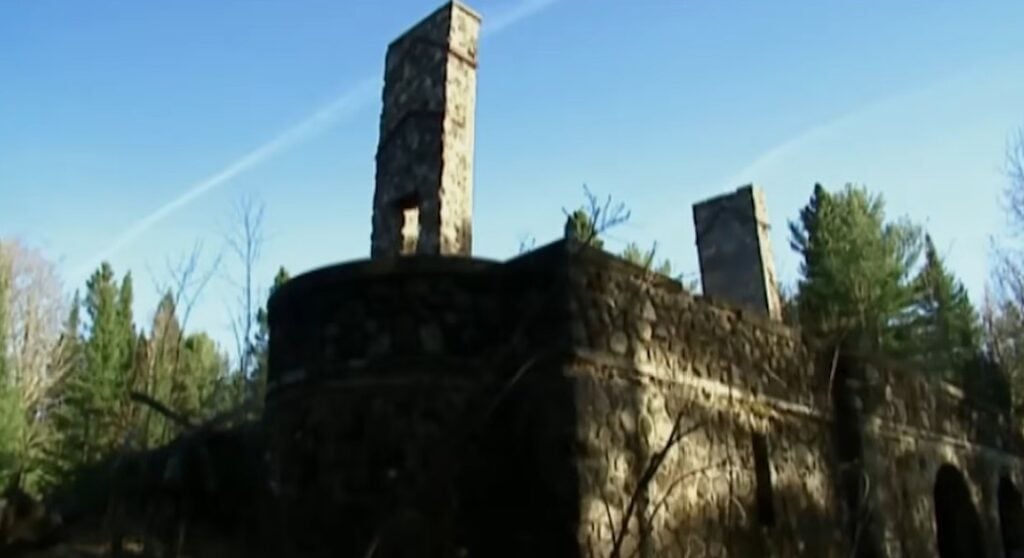
Located not too far away from Land O’ Lakes, Wisconsin, on the southern banks of West Bay Lake, Summerwind Mansion — or, perhaps, the Lamont Mansion, or LaMonte Mansion, or Lilac Hills; it’s gone by many names over the years — was once one of Wisconsin’s great stately summer homes. It has, however, since become a shell of itself.
[Like what you read? Check out Dangerous Games To Play In The Dark, available from Chronicle Books now!]
No one has lived in Summerwind Mansion for many decades. Not since the fire, that fateful night in 1988.
But even before then, Summerwind Mansion hadn’t been a home in some time. The place has long had a reputation, you see, not just as a ruin, but also something… else.
Summerwind Mansion is abandoned.
And Summerwind Mansion, some say, is haunted.
Or at least, that’s how the stories go. The truth of the matter is that Summerwind Mansion is probably not actually haunted; indeed, the stories that claim it is have… questionable sources, and may be more manufactured than anything else.
But the house itself is real. The fire that destroyed is real. And the ruin is very, very real. It’s still there today, hiding in plain sight — although it’s worth noting that, unlike some of the abandoned locations we’ve looked at here at TGIMM, it’s privately owned and not accessible to the general public.
The story is fascinating all the same, though, so let’s take a look, shall we?
Gather ‘round: Here’s the tale of Summerwind Mansion, from its humble beginnings to its fiery end.
From Lilac Hills To Summerwind Mansion: A History Of Wisconsin’s Eeriest Ruin
Tracing the actual history of Summerwind Mansion is a little difficult. It’s not well documented, and there are conflicting dates for key moments all over the place — not to mention all the half-truths and vague rumors that are often brought up in conjunction with the property.
The clearest account of Summerwind’s early years that I’ve been able to find comes from historian Kerry Bloedorn as part of the “Connecting The Dots” feature he hosts for Rhinelander area NBC affiliate WJFW. Per Bloedorn, who reported the “Connecting The Dots” segment on Summerwind in September of 2023, the property was originally a fishing lodge: Sometime in the early 20th century, blacksmith-turned-homesteader John Frank built the lodge and a handful of cabins, calling it West Bay Lake Resort.
Robert P. Lamont, engineer and later Secretary of Commerce for Herbert Hoover, entered the picture around 1916, purchasing the property from John Frank and enlisting Chicago architectural firm Tallmadge and Watson to design what would become the Lamont family’s lavish summer home.

No modest cabin this, the resulting mansion took two years to complete. Comprising 20 rooms and a terrace, all with excellent views of West Bay Lake, it cost about $125,000 — close to $3.7 million in 2025. The Lamonts referred to it as Lilac Hills, although locally, it became known simply as Lamont Mansion, or LaMonte Mansion, as it’s sometimes rendered.
The Lamonts had — somewhat curiously — ceased using the mansion by the 1930s, although it remined in the family’s possession. Robert Lamont himself died in 1948 at the age of 80, by which point Lilac Hills had sat vacant for many years.
Here, it gets more difficult to trace the mansion’s ownership and history; things get wibbly real fast, and sources get more scattered. Additionally, who had ownership of the house versus who was in residence at the house may not always have been one in the same, and it’s not always clear when we’re talking about one versus the other.
In any event, after Lamont’s death, the estate changed hands and/or residents numerous times. First, it’s usually said, there were the Keefers; however, Mr. Keefer — no first name given — reportedly suffered a fatal heart attack shortly after purchasing the estate, leaving it in the hands of his wife, Lillian. Lillian subsequently began parceling off the property and selling it, bit by bit.
When only the mansion itself remained, Arnold and Ginger Hinshaw either purchased it or simply took up residence in it sometime in the late 1960s or early 1970s. (1969 is sometimes given as the year, as it is in a writeup from the paranormal investigation group Paranormal Milwaukee, though much of the time, it’s left rather more vague.) It’s sometimes reported here that the Hinshaws had six children who lived in the house with them; or, alternatively, it’s reported that “a family of eight… lived there in the early 1970s,” without the specific identification of the family being the Hinshaws themselves.
Regardless, Summerwind wasn’t in terrific repair at the time, and the Hinshaws made an attempt to fix it up while they were there. They didn’t quite manage to do that, however, and after the Hinshaws’ time in the mansion — which may have been only as long as six months and went… interestingly (we’ll get there, I promise) — they may have sold it back to the Keefers. Either that, or the Keefers had always maintained ownership, and the Hinshaws simply moved out. Again, things are wibbly here.
This is when Raymond Bober enters the picture, although it’s not clear whether he bought the property, or whether he just lived on it.
An article published in the Milwaukee Journal on Oct. 21, 1985 — which, it seems, was an excerpt from the book Haunted Heartland by Michael Norman and Beth Scott, originally published in January of 1985 — notes, for instance, “There is some uncertainty as to whether Bober ever actually owned Summerwind. One area resident told Pooley that Raymond Bober had tried to buy the property on a land contract, but was unsuccessful.” (The “Pooley” mentioned here is freelance writer Will Pooley, who spent time in 1983 visiting, researching, and reporting the many stories associated with Summerwind.)

Furthermore, a different article — also published in the Milwaukee Journal, although on Feb. 11, 1985, some months earlier than the previously mentioned one — states that Bober was only on the property briefly; that he “never spent a night in the house” and instead “lived in a trailer” parked on the land, according to a neighbor; and that, at the time of writing, taxes on it were paid not by Bober, but by a Henry A. Walters, who was living in St. Croix.
It’s absolutely worth noting, by the way, that Raymond Bober was Ginger Hinshaw’s father — and his time on the property, however brief, would turn out to be a big reason the place has developed such a substantial mythology over the years.
Again, we’ll get to that. I promise.
Anyway, Bober was no longer in possession of or in residence at the property by the mid-1980s. Per an article published in the June 23, 1988 issue of the Wisconsin State Journal, Summerwind Mansion was purchased in 1986 by Harold Tracy, Jerry Olk, and Roger Pfohl — who, it seems, bought it not from Bober, or from the Henry A. Walters who had been paying taxes on the place in 1985, but from the estate of Lillian Keefer. (Again, you can see how it might be possible that the Keefers actually remained the owners of the property throughout all of the post-Lamont decades, with the Hinshaws and Bobers merely renting the place out from them or something like that.) Lillian Keefer herself had since passed.
As far as I know, no one was actually in residence at Summerwind during this period. Nor would they ever again — because that 1988 article is important for more than just tracking the house’s ownership. It’s also, you see, the report that documents what happened to the house next — the reason the house became a ruin: On June 19, 1988, Summerwind Mansion was struck by lightning, starting a massive fire that burned the place to the ground.
There have been a few claims since that it wasn’t a lightning strike that started the fire, but a deliberate case of arson; however, these claims are unsubstantiated, and the official story from the fire department remains that it was lightning.
But, no matter what the source of the fire may or may not have been, one thing is for certain: Summerwind Mansion has remained a ruin ever since.
The (Alleged) Haunting Of Summerwind Mansion
Remember all those things I said we’d get to eventually?
It’s time to get to them.
They’re about Summerwind Mansion’s… other reputation. Not the one about it being a once-grand estate that’s been destroyed and seemingly abandoned; the one about it being… haunted.
Allegedly, at least. The stories are rather suspect, but I’d be remiss if we didn’t take a look at them here, so… let’s do this thing.
It’s sometimes said that the first incident suggesting that the house now known as Summerwind Mansion might be haunted happened all the way back during the Lamont family’s years in it — when it was called Lilac Hills.
Supposedly, one night about 15 years after the completion of Lilac Hills, a full-on apparition appeared in the kitchen — one that terrified Lamont himself so much that he drew a pistol and shot at it, leaving two holes in the basement door. This supposed incident is sometimes cited as the reason the family quit the house, although as a 2018 report from the Rhinelander-based public radio station WXPR notes, there’s nothing in Lamont’s own writings to corroborate this story as having actually occurred. I’m not sure what the original source for it might be, though I do have some… suspicions. (In due time, friends. In due time.)
The Hinshaws, meanwhile, reportedly experienced a great deal of unrest while they were living in the house, per Haunted Heartland: Shadows floating down the hallways; disembodied voices drifting through the rooms; windows and doors that were closed at night found open in the morning; and — most notably — a hidden compartment located within the back of a closet in which the Hinshaws claimed to have discovered a human skeleton and/or other human remains. Upon a second investigation later on, the alleged remains were no longer present. Both Arnold and Ginger experienced sharp declines in their mental health while living in the house, and sometime after they moved out, they divorced.
The weirdest stories by far, however, come from Ginger’s father, Raymond Bober — or, more accurately, from a truly wild book Bober published in 1979 under the name Wolfgang von Bober. He called it The Carver Effect: A Paranormal Experience.

According to Bober, Summerwind Mansion was haunted by the ghost of 18th century explorer Jonathan Carver. Born in what’s now Weymouth, Massachusetts in 1710, Carver spent several of his later years exploring along the upper Mississippi River, including parts of Wisconsin, Minnesota, and Iowa.
Bober claimed that Carver’s spirit was in search of a lockbox that had allegedly been sealed in Summerwind Mansion’s foundations — one that supposedly contained a deed granting land amounting to roughly the entire northern third of Wisconsin to Carver. The land, Bober claimed, had been deeded to Carver by a Sioux tribe as a gift following Carver’s supposed successful negotiation of peace between several warring nations. Bober wrote that Carver had communicated all of this to him via dreams and trances and through the use of a Ouija board.
As WXPR noted in 2018, none of this can be corroborated.
And, I think it’s worth noting, Carver died in England — not Wisconsin; not even the United States — in 1780, some 125 years before West Bay Lake Resort/Lilac Hills/Summerwind Mansion would even be built.
But Bober and his book are, it seems, responsible for most, if not all, of the mythologizing about Summerwind that continues to this day. Indeed, a not-insignificant number of locals told various reporters over the years that the house had never had any sort of reputation for being haunted until after Bober started spreading his account. (I suspect, by the way, that Bober might also be the source of the supposed incident the Lamonts allegedly experienced when the house was still Lilac Hills.)
Heck, the name Summerwind Mansion might even originate in The Carver Effect; as Kerry Bloedorn’s “Connecting The Dots” segment on the place states, “It was [Raymond Bober] who began referring to the mansion as, Summerwind, a name that has stuck all these years later.” Up until that point, it was known locally as Lamont Mansion — and outside of the local community, it mostly wasn’t known at all.
Or at least, it wasn’t until the November 1980 issue of Life Magazine was published. This issue featured what had finally become termed Summerwind in a piece about the most (allegedly) haunted places in the United States.
And the rest, as they say, is history. Questionable history, perhaps, but history all the same: Because the house and property’s name and reputation — that it’s called Summerwind Mansion, and that it is both extremely ruined and extremely haunted — have stuck with the place ever since.
Where Are They Now?: Allegedly Haunted Ruin Edition
Reputation aside, you’re probably wondering what the current status of the ruins of Summerwind are. Does anyone own them? Are there plans for them? Can you visit them? Should you visit them?
The answer to that first question is that, yes, someone does currently own them; meanwhile, the answer to the second is that there were plans — and have been plans a few times since — to do something with them, but that none of those plans have ever successfully gotten off the ground.
An article published at the Quad City Times on Oct. 29, 1995, elaborated a little on the trio of folks who purchased the place in 1986 — Harold Tracy, Jerry Olk, and Roger Pfohl. They had purchased it together for $20,000 (just shy of $645,000 in 2025) with the intention of turning it into a bed and breakfast; but the project never came to fruition, with most of the investors backing out.
“Certainly, now I’m out of the deal,” Olk told Quad City Times’ Bill Wundrum, citing the fact that “in everyone’s mind around here, it’s a still a haunted place” as the reason.
Pfohl, meanwhile, seemed to have had a rougher time of it; he told Wundrum, “My life has been a nightmare since buying an interest in that place. I lost a franchise business. My best friends, who co-owned Summerwind with me, weren’t speaking to me. I had a psychic visit it. He got out in a hurry, said it was so spooked that even he wanted no part of it.” He also experienced a near-fatal explosion while working on a project in his boat house not too long before publication of the report, fueling the belief that Summerwind was cursed.
That left Harold Tracy, who at the time still owned Summerwind along with his wife. Wundrum reported that Olk suspected they might sell it — he estimated the place might have brought in about $100,000 at the time (the equivalent of about $210,000 in 2025) — but it’s not clear whether that ever happened.
In 2014, there was an attempt to launch a revitalization project, but it, too, was seemingly abandoned; possible schisms seem to have occurred within the group of people who had been working on the project, with at least one of the co-founders since having left and moved onto other things.
As of 2019, per Paranormal Milwaukee, the property — which is currently one and a half acres, down from the 80 it had been when Lilac Hills was first built — has a value of about $246,000; its owners at the time lived in Eau Claire, Wisconsin, quite some distance away from West Bay Lake. Paranormal Wisconsin doesn’t provide any names here, so it’s not clear whether the Tracy family still owns it or whether it changed hands again at some point.
Rumors were passed around on various Facebook pages in 2023 that the property was for sale, though after a lot of digging, I’m pretty sure that’s all they were — rumors. I’ve found no evidence from any reliable sources that the property was actually on the market at that time.
As for whether you can visit it? That would be a no, mostly. Again, it is privately owned, and trespassing is a no-go. It’s also likely to be terribly unsafe, as it’s undergone no preservation since the fire. Sometimes there are official tours, but those are few and far between. You can see what it looks like now here, if you like.
And besides.
Even if it’s probably…
…Almost certainly…
…Not actually haunted…
…You wouldn’t want to risk it, would you?
…Would you?
***
Follow The Ghost In My Machine on Bluesky @GhostMachine13.bsky.social, Twitter @GhostMachine13, and Facebook @TheGhostInMyMachine. And for more games, don’t forget to check out Dangerous Games To Play In The Dark, available now from Chronicle Books!
[Photos via A Haunting (1, 5)/YouTube; Wikimedia Commons (2, 4,), available in the public domain]


Leave a Reply