Previously: The Pied Piper & What Happened In Hamelin.
What would you do if, one day, while you were digging around in your garden or yard or what have you, you dug up what appeared to be two small heads made from stone? Me, I would probably move from “What the heck???” to “Oh, these are probably (absolutely) cursed” to “COOL, CURSED HEADS!” very, very quickly, mostly with the understanding that they probably weren’t actually cursed. In the case of the Hexham heads, things went similarly… to a point. The Hexham heads mystery starts with “What the heck???”, moves to “Oh, oh these are probably cursed,” and then winds up with, “But what happened to them? What happened to the Hexham heads?”
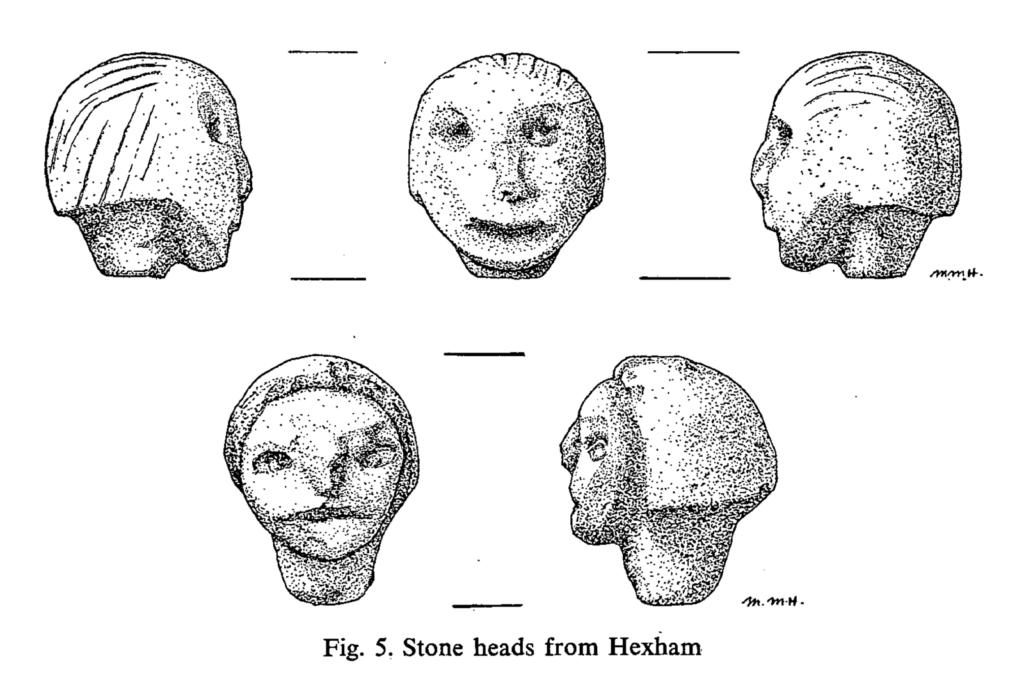

Because that’s the thing: Initially discovered in the back garden of a council house in the UK in the 1970s, the Hexham heads have been missing for decades. What’s more, they went missing before anyone satisfactorily figured out what they even were in the first place.
[Like what you read? Check out Dangerous Games To Play In The Dark, available from Chronicle Books now!]
The other thing with the Hexham heads — what they were, what happened with them while they were around, and where they’ve disappeared to since — is that it’s one of those stories where the line between and fact and… embellishment is very, very blurry. How “true” any of the reports from the time during which they were in various peoples’ actual possession happen to be will, at this point, largely be dependent on where readers themselves fall on the “ghosts, curses, and cryptids are/aren’t real” spectrum of belief.
But the mystery — mysteries, really; they’re plural — remains, and although we’re unlikely ever to solve them, they’re still fascinating to look at.
So let’s do that, shall we?
Here’s the strange, mysterious story of the Hexham heads: What we know, what we don’t know, and everything in between.
The Mystery In The Garden: Finding The Hexham Heads
The Hexham heads made their first appearance sometime in the early 1970s. Both 1971 and 1972 have been reported as the years; at least one report specifies February of 1972 in particular, although others state that the identification of the year as 1972 is erroneous. In any event, those first few years of the ‘70s are the key time period here: That’s when Colin Robson, then 11 years old, and his younger brother Leslie, known as Les, found the two heads buried in the back garden of their home, 3 Rede Avenue, in Hexham.
The heads, as investigative journalist David Clarke put it in the second volume of his 1999 work The Head Cult: Tradition And Folklore Surrounding The Symbol Of The Severed Human Head In The British Isles, were roughly the size of a tennis ball — a little smaller, perhaps — though much heavier, owing to the fact that they seemed to be solid stone. They named them, eventually: The one they called “the boy” was a sort of grey-green with speckles of sparkling quartz, and resembled a skull onto which lines perhaps intended to represent hair had been etched; meanwhile, the one they called “the girl” or “the witch” was characterized by hair painted yellow or red combed back from its face, and what Clarke calls “wild bulging eyes.” Archaeologist Kenneth Brophy further writes in his excellent series on the Hexham Heads over at his site, the Urban Prehistorian, that both heads had “some kind of protrusion from the neck that [suggested] they were once joined to something else, maybe a little body or a pedestal.”
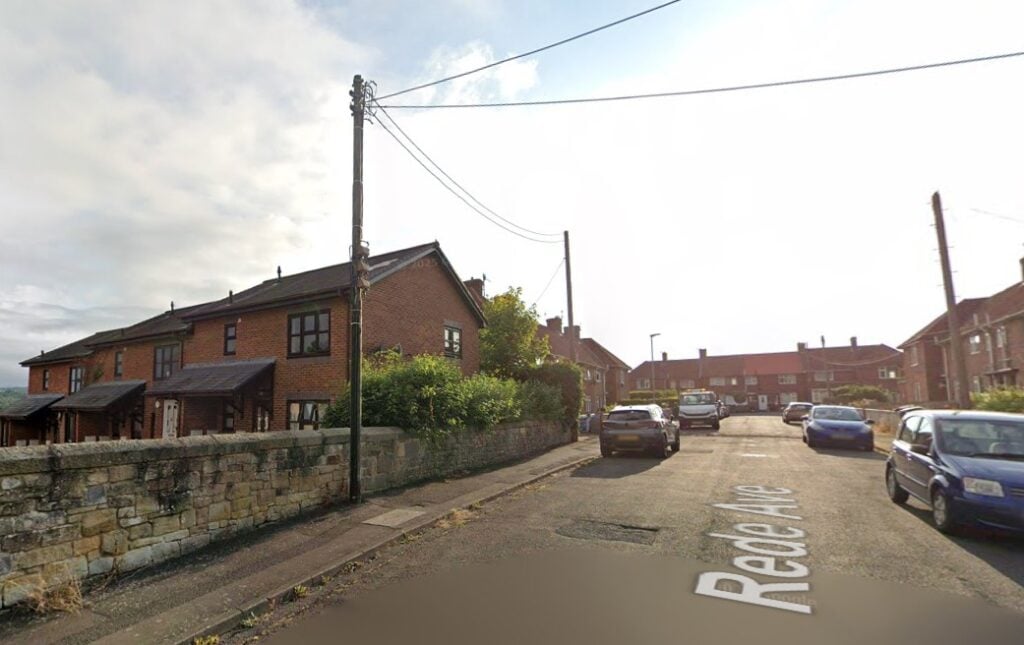
The boys gathered the heads and brought them into their home — and that’s when, it’s said, the… incidents began.
As it’s usually described, the activity sounds rather like the variety that’s often associated with alleged poltergeists. (Tangentially related: The infamous Enfield poltergeist case also occurred around this time; the activity there started in 1977. I’m not suggesting the two are directly related — and Enfield is clear on the other end of the UK from Hexham, anyhow, some 450 kilometers away — but it’s still perhaps worth noting for the sake of historical context.) According to the claims, this activity included the heads moving on their own, rotating in place to face a different direction than the one in which they had been placed; objects breaking, including glass shattering over the bed of one of the other Robson children; and, around Christmas that year, two things occurred at the site where the heads were found: An odd flower bloomed in the dead of winter, and strange lights were seen.
But poltergeist-like activity wasn’t the only thing to be allegedly reported in the neighborhood after the heads made their first appearance.
There was also the werewolf.
This report came from the Robson’s next-door neighbor, Ellen Dodd. Per Peter Brookesmith’s 1984 book Incredible Phenomena, Dodd described her experience as follows:
“I had gone into the children’s bedroom to sleep with one of them, who was ill. My 10-year-old son Brian kept telling me he felt something touching him. I told him not to be so silly. Then I saw this shape. It came towards me and I definitely felt it touch me on the legs. Then, on all fours, it moved out of the room.”

Brookesmith writes that, according to Dodd, whatever had touched her appeared to be “half human, half sheeplike”; in a further comment from the Robson family, Dodd had apparently told them the creature had been “like a werewolf.” It’s been suggested that whatever Dodd experienced may have been a reappearance of the Hexham wolf or Allendale wolf — a grey wolf which, following an escape from a local zoo in 1904, spent some time ripping through livestock in Northumberland — though I don’t believe theory ever really picked up steam, due to the fact that grey wolves don’t live nearly that long.
In any event, after finding her front door ajar following the alleged encounter, Dodd went to the local council and was moved to a different house.
The heads were subsequently removed, and an exorcism performed on the Robsons’ house. No further activity was reported on Rede Avenue, either at no. 3 or in any of the other homes.
The Cult Of The Head: The Hexham Heads On The Move
This is when Dr. Anne Ross enters the picture.
Ross, who received both her MA and her PhD at the University of Edinburgh, was (and is still, as far as I know, although she passed away in 2012 at the age of 86-87) widely considered one of the UK’s preeminent scholars of Celtic culture and religion; she was also, however, somewhat divisive, due to her beliefs surrounding the paranormal. Regardless, she was an expert particularly on what’s usually referred to as “the cult of the head” — a theory that ties together the surprisingly large amount of stone heads and other archaeological finds into a proposed Celtic belief system centered around the worship of the human head. (Clarke’s work, previously noted, also focuses frequently on the cult of the head.)
In any event, the heads came into Dr. Ross’ possession for a period of time not too long after they were first discovered; they had been sent to her for study in her capacity as an expert on the cult of the head. On that front, she believed the heads to have been carved from Northumbrian stone — local to the area in which they were discovered — possibly during the Romano-British period, which spanned 43 CE to 410 CE. (We’ll return to this in a bit, though, as the heads’ geological makeup and origin are… disputed.)
But what Dr. Ross reported occurring at her home while the heads were in her possession was a bit less academic.

In the introduction to the now-out-of-print Reader’s Digest volume Folklore, Myths, And Legends Of Britain, originally published in 1973, Ross recounts her experience with the heads. She writes:
“Though there was nothing unpleasant about the appearance of the heads, I took an immediate, instinctive dislike to them. I left them in the box they had been sent in, and put it in my study. I planned to have them geologically analysed [sic], and then to return them as soon as possible to the North.”
However, several nights after their arrival, she woke in the early morning hours, “deeply frightened and very cold,” to the sight of a “tall figure” — one “dark like a shadow” which seemed “part animal and part man” to her eyes — exiting from her and her spouse’s bedroom into the corridor. She followed the figure downstairs, where it moved towards the kitchen, at which point she returned upstairs to wake her spouse. A search of the house revealed nothing — no evidence of intruders or any other “disturbance.”
Later, Ross’ daughter, then a teenager, had a similar experience, spotting “something huge, dark, and inhuman” on the stairs when she was alone in the house; again, though, a search of the home found nothing out of the ordinary.
“Since then,” said Ross, “I have often felt a cold presence in the house, and more than once have heard the same soft thud of an animal’s pads near the staircase. Several times my study door has burst open, and there has been no one there and no wind to account for it.” What’s more, even after the heads were returned to the museum that had sent them to her in the first place — the Newcastle Museum of Antiquities, which has since merged its collection with the Great North Museum: Hancock — the presence, she said, remained.
Stories In Stone: The Hexham Heads And The Stone Tape Theory
In 1977, the Hexham heads came into the possession of chemist Don Robins, who chronicled his experience with the heads in his 1988 book The Secret Language Of Stone. Like Anne Ross, Robins was a similarly controversial figure due to his views on the paranormal; in particular, as Kenneth Brophy notes over at the Urban Prehistorian, Robins hoped the Hexham heads might help prove the stone tape theory — that is, the idea that memories, images, or emotions, if sufficiently strong, can be literally encoded in stone and released or replayed like a recording when the surrounding conditions are correct.
Indeed, it was a pitch Robins sent to the magazine The Ley Hunter regarding the stone tape theory examined through the lens of the Hexham heads that led to his direct involvement with the case: Upon receiving Robins’ pitch, editor Paul Devereaux not only responded with interested, but told Robins that he had found the pitch compelling enough to reach out to Anne Ross herself.
At the time, Dr. Ross was at Southampton University — and, it turned out, so were the heads. They had ended up in the university’s geology department following their time up north, and after Robins took over the communiqué from Paul Devereaux, he arranged a trip to Southampton to meet with Dr. Ross and see the heads himself in late September of 1977.
Robins did not actually intend to take the heads home with him after this visit; he had assumed he would be able to look at them and take some photographs of them, but nothing more. Indeed, he writes that he “came to near panic” when presented with the opportunity to take them with him when he left; the idea of “that wall-eyed stare, which still seemed to transfix [him] when the heads were back in their box” being something that came home with him was not particularly appealing, given the heads’ history and the reports surrounding their alleged activity.
At the same time, though, he realized it was “an offer [he] couldn’t refuse,” so after that visit to Southampton University, the heads journeyed with Robins to his home in London.
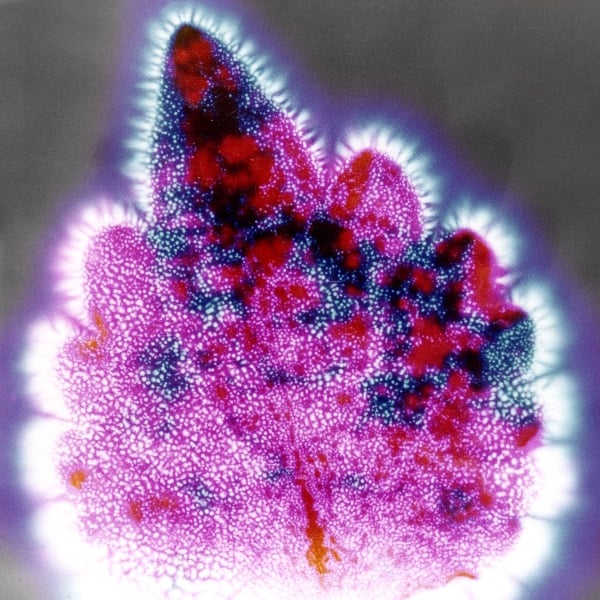
During the following two months, he kept the heads outside, mostly; the first night, he simply stashed them under a tree out in the back garden, though they spent most subsequent nights in his shed. However, after an attempt at photographing them using Kirlian techniques resulted in a series of blurred images, which Robins found to be significant — as he put it in The Secret Language Of Stone, “One of the hallmarks of the paranormal, especially relating to UFOs and alien animals, is the inability of observers to photograph them at the critical moment”; given that the photographs were taken under controlled circumstances with highly trained technicians, he found it odd that they still came out fuzzy and overexposed — he began keeping them inside the home itself, moving them from location to location in the hopes of observing unusual activity surrounding them.
They sat, variously, on the mantel, near the stairs, and on top of a bookshelf in an upstairs room of the home — and although Robins didn’t experience anything like what previous keepers of the heads had experienced, he did note feeling an odd sense of foreboding while in the presence of the heads on more than one occasion, and once reported a sort of “electric tingling.”
In 1978, Robins brought the heads to Frank Hyde, who Robins describes as an astrologer. Hyde had apparently gotten in touch with Robins after reading some of the writing he had been publishing about the Hexham heads during his time with them; he was interested in seeing whether the heads would respond to divining techniques.
At Hyde’s home in Kilburn, in the northwest of London (fun fact: that’s not too far away from where I lived during the time I spent in that particular city), various experiments with the two heads involving pendulums, rods, and other such tools seemed to show results from one of the heads in particular: The one usually referred to as “the witch.”
When Hyde asked if Robins would leave the heads with him for further experimentation, Robins agreed.
And this, unfortunately, is where the heads themselves — the physical objects — exit the narrative: Robins heard nothing further from Hyde. He later learned through mutual acquaintances that, not long after taking possession of the heads, Hyde had been in a serious car accident; after that, though, Hyde became unreachable — and the heads vanished with him. It’s not known what happened to Hyde or where he may have gone, and the same goes for the fate of the heads.
The Hexham heads have never been recovered, and remain lost.
What Were The Hexham Heads, Anyway?
But what happened to the Hexham heads — where they may have gone, or where they may have ended up — is not the only mystery surrounding them. The other big one is this: What, exactly, are they? Everything from their geological makeup to the era they may date back to, and from what their function was to how they were made in the first place, remain unknown — though not for lack of trying.
One of the earliest surface examinations, performed by Frank Hodson — at the time a professor of geology as well as the dean of the faculty of science at the University of Southampton — and included as a footnote in Anne Ross’ 1973 paper “Some New Thoughts On Old Heads” in the journal Archaeologia Aeliana, asserted that the heads were both made from “a very coarse sandstone with rounded quartz grains up to 2mm in diameter in a calcite cement.” They seemed to have been “plastered over with lime,” which accounted for the heads’ smooth surfaces — a texture that Hodson believed would have been unachievable by polishing sandstone as coarse as that which seemed to make up the heads themselves.


The sandstone “could well have come from the vicinity of Hexham,” Hodson wrote, noting that officials from the Leeds Office of the Institute of Geological Sciences had told him that this variety of sandstone could be found “below the Durham ‘Millstone Grit’ and especially in a bed just below the Little Limestone, north of Hexham’”—that is, the heads could very well have been made from local material, and therefore originated in the area in which they were found.
However, a second analysis performed a year or so later by Dr. Douglas Robson (whom I believe bears no relation to the Robsons who unearthed the Hexham heads in the first place) of Newcastle University arrived at quite different conclusions.
Initial observations in Dr. Robson’s report included the fact that, although lots of sandstones occur in and around Hexham, “none of them bear any similarity to the material from which these heads have been formed ” —and that, furthermore, the material itself was also “unlike any natural sandstone.”
So, if not sandstone, then what? Per Dr. Robson’s analysis: “An artificial cement” with grains “probably derived from the sea-shote,” accounting for the uniform size of the grains and the level of rounding and polishing they displayed.
The analysis did not attempt to date the heads, but did offer two possible explanations for how they could have been made during two different eras. If of “modern origin,” they were likely made using builder’s sand — a construction material usually sourced from river beds, quarries, and seashores that can be used in projects ranging from concrete production to mortar mixing; meanwhile, if of “ancient origin,” the report posited that “presumably some enterprising Hexham Briton, struggling through the swamps of the Tyne valley, may have visited the seaside and have come back with a satchel of sand which he subsequently mixed with ground-up limestone and water.”
And then there’s this: Not too long after the heads were first discovered — and, perhaps more notably, not too long after they started to gain public notoriety — a man came forward claiming to have made the heads himself.
Desmond Craigie, a local Hexhamite, said that he was responsible for the heads’ creation. They were toys made of concrete, he said, which he had made in the 1950s — specifically 1956, it’s sometimes reported — for his young child. At the time, Craigie had worked a company that processed and reused cement, which was how he had access to the materials; furthermore — and perhaps most astonishingly — he had lived at 3 Rede Avenue then, in the house that would later become home to the Robson family.
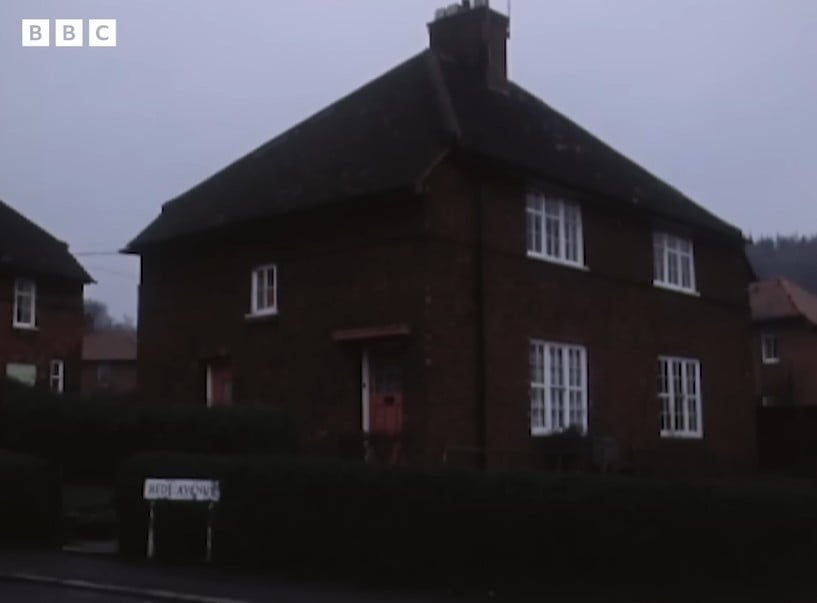
There had once been three heads, Craigie claimed, but one had broken and been thrown out long ago; the other two, subsequently, had been lost — which, presumably, was how they had ended up in the garden for the two Robson boys to find decades later. Craigie even made several additional heads in an attempt to prove his claim.
However, this claim has since been discarded. The additional heads Craigie made to support his story were deemed not similar enough to the originals to provide sufficient proof of the claim, and with no other actual evidence backing it up, the idea was dropped (although I believe Craigie did continue to stick to his story even as the decades ticked by).
But although it’s generally accepted that Craigie’s claim is probably not the case, nothing definitive has ever been determined about what the Hexham heads were made of, how they were made, or even how old they are — and without the heads themselves, there’s no way to perform any further examination or analysis to get to the bottom of all these questions.
And so, the mystery endures.
Footage, Found: The Recovery Of A Lost Hexham Heads Report
Even though the Hexham heads themselves remain lost, however, a startling discovery related to them was made fairly recently.
In 1976, the BBC1 aired a segment on its weekday news program Nationwide about the Hexham heads. A slightly unusual choice for a current affairs program? Sure, but weirder things have been featured on television news programs. Besides, Nationwide, which ran from 1969 to 1983, followed a magazine format, with lighter stories interspersed between the heavier ones.
In any event, the segment, which was reported by Luke Casey, was notable for a few reasons: First, it featured Anne Ross’ account of her time with the heads as told by Dr. Ross herself; second, it was only aired once; and third, despite having only aired once, it loomed large in the memories of many who saw it for many decades to come.
Why did this relatively innocuous nine-minute segment stick so strongly in many Britons’ collective memories? Because of its inclusion of — for lack of a better term — jump scares: In addition to the as-to-be-expected footage of other Celtic stone heads, Anne Ross speaking in her talking head-style interview, and Casey himself on the reporting beat, some rather unexpected footage from 1961 Hammer Horror film The Curse Of The Werewolf was also spliced into the report to add some flavor to the monster-centric nature of Ross’ own story.

But here’s the thing: The segment was, for decades, considered mostly lost media. The actual footage still existed — but the audio was missing, so all we had were the images of the segment, not the words of the report.
In October of 2024, however, part of the audio for the segment was recovered — and not only that, but crucially, it was the audio belonging to the second half, which primarily consists of Dr. Ross’ account of what she said happened in her home when the Hexham heads were in her possession. And on Oct. 31, 2024 — Halloween — the BBC Archive released the segment with the audio restored in the second half, and reconstructed as much as possible from written news reports about the segment to fill out the first half.
It doesn’t really tell us much more about the Hexham heads themselves — but it’s still a worthwhile tidbit to revisit, as it provides a bit of a time capsule as to what was going on in the zeitgeist during the time that the story was actively unfolding. You can watch it here, at the BBC Archives YouTube channel; the restored audio begins at around the 5:20 mark, although the first half is still worth watching, too, thanks to the useful context and approximated audio supplied by the archive.
Luke Casey, alas, did not live to see this segment restored; he passed away in 2022 at the age of 80 after a long and fruitful career.
Where Are They Now? The Legacy Of The Hexham Heads
Although the many mysteries of the Hexham heads will likely never be solved, the story persists — and there’s an awful lot of interesting stuff to read about them in the meantime.
I’ll point you primarily towards the previously-mentioned five-part series on the Hexham heads by Kenneth Brophy at his Urban Prehistorian site and to the two resources pages at this exhaustive if otherwise unnamed Hexham heads research base. The Urban Prehistorian series is an excellent rundown of everything we know about the heads and their story — and everything we don’t know; the research base, meanwhile, is generally no longer being updated, but remains a treasure trove of resources, including PDFs and scans of otherwise difficult-to-find sources.
Also, for funsies: Electronica artist the Night Monitor, aka Neil Scrivin, released a concept album-ish situation inspired by the Hexham heads in 2024; titled Horror Of The Hexham Heads, it’s available on Bandcamp. The Night Monitor has an album inspired by the Black Monk of Pontefract, too — also released in 2024 — so if you dig the idea of moody, experimental music inspired by some of the weirder moments of mid-to-late 20th century UK cultural moments, you’ll probably find this artist in general to be a fun listen.
Just, y’know.
Don’t lose your head over it.
***
Follow The Ghost In My Machine on Bluesky @GhostMachine13.bsky.social, Twitter @GhostMachine13, and Facebook @TheGhostInMyMachine. And for more games, don’t forget to check out Dangerous Games To Play In The Dark, available now from Chronicle Books!
[Photos via Mary Hurrell, MrX, Derek Harper/Wikimedia Commons, available under CC BY 4.0, CC BY-SA 3.0, and CC BY-SA 2.0 Creative Commons licenses; screenshot/Google Street View; NTNU, Faculty of Natural Sciences/Flickr, available under a CC BY 2.0 Creative Commons license; BBC Archive (4, 8), Horr0re Video Links, ScreamFactoryTV/YouTube; thenightmonitor/bsky]


Leave a Reply