Previously: Dokkaebi.
Type: CC (Corporeally Challenged).
Period/location of origin: Subject, the Kong Kong Kong Ghost, achieved its height of popularity in the 1990s, although it is unclear whether this is also subject’s period of origin. Subject originates in Korea.

Appearance: Subject, known as Kong Kong Kong Gwishin (콩콩콩 귀신), Kong Kong Kong Ghost, or Knock Knock Knock Ghost, is, as its name might implied, more often heard than seen. However, if or when subject reveals itself, subject appears to be a high school student who is clearly… no longer a living high school student. They may be of any gender, and will be seen wearing whatever version of their former high school’s uniform they wore in life.
Their key defining characteristics are as follows: They are covered in blood, and they are oriented upside down — as if they fell, head first, from a great height, and remain frozen in that position forevermore.
[Like what you read? Check out Dangerous Games To Play In The Dark, available from Chronicle Books now!]
Modus operandi: Subject is extremely selective about their targets; there are specific criteria one must meet in order to become a target, though what all targets have in common is a predisposition towards jealous and a willingness to act on their worst impulses. (See: Additional notes.) Once a target has been selected based on highly specific criteria, subject will wait until that target is alone in a school environment, afterhours or at night, in an area characterized by rows of doors — often either a classroom off a long hallway filled with other classrooms, or a bathroom with a row of stalls.
The school environment may be an actual high school, although it may also be a doksuhshil (독서실) — a reading room or study room — or a hakwon (학원), an academic preparatory academy similar to a cram school.
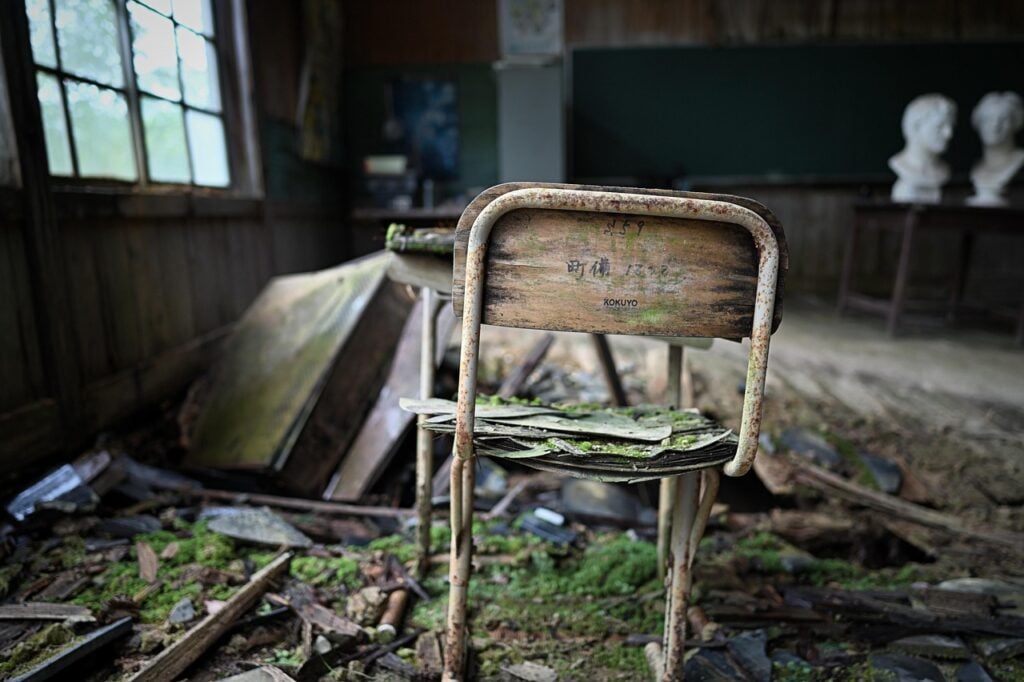
Whether a target meeting all the requisite conditions is either studying in an empty classroom, a or a or occupying a restroom stall, they may begin to hear odd noises — noises that sound as if something heavy is knocking on a wall.These sounds typically come in sets of three, after which they may be followed by a different sound — a crack, a crunch, or, sometimes, a squelch.
Kong… kong… kong… crunch.
This sequence of noises will repeat, over and over and over.
That sequence may sometimes be interrupted by the sound of a door creaking open — either a classroom door, or the door of a restroom stall. And, following the sound of the door, target — if they are paying attention to their surroundings; if they are listening closely — may hear a voice saying:
Nobody here.
Target may at this point choose to do one of three things: Attempt to ignore the sounds; seek to find the source of the sounds; attempt to hide; or attempt to leave. It is unknown what happens should targets attempt to leave — reports solely regard targets who remained where they were — but, should a target attempt to ignore the sounds, seek to find the source of the sounds, or choose an unwise location to hide, such as underneath a desk, they will, simply put, be caught.
Eventually, you see, the sequence of sounds—
—Kong… kong… kong… crunch; the squeal of a hinge—
—Will result not in the words Nobody here.
They will result in these words, instead:
Found you.
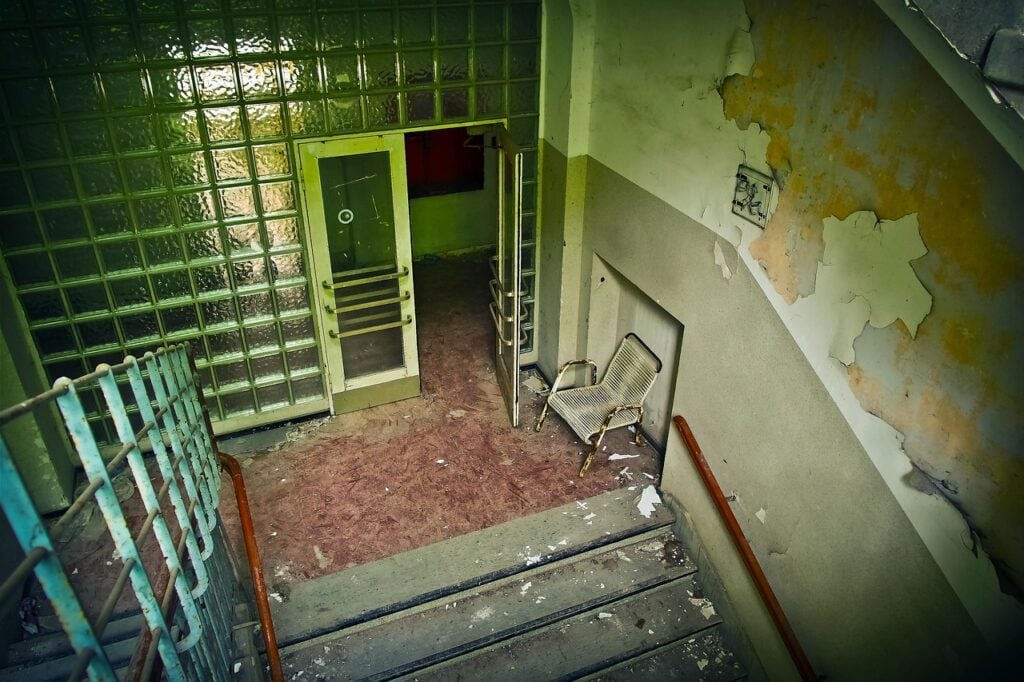
The last thing target will see before they expire will be subject, covered in blood, upside down, grinning a rictus grin.
The noise was not something heavy knocking on a wall.
The noise was something heavy — something roughly the size and weight of a bowling ball, although expressly not a bowling ball — knocking on the floor.
After all, how else is someone whose head is on the floor and their feet pointed to the sky meant to get around?
Containment: It has been suggested that a target may successfully avoid being caught if they hide not under something, but on top of something — that is, not somewhere low, but somewhere high. Instead of underneath a desk, for instance, they may hide on top of a desk.
Similarly, if targets encounter subject in a restroom, choosing to stand on the toilet, rather than to look beneath the walls of the stall in an attempt to find the source of the sounds, may allow them to avoid being caught.
Subject, after all, can only see what’s in front of them — and their eyes are very low to the ground.
The other way to avoid becoming a target, of course, is not to take any actions that might result in the creation of subject in the first place — or, at the very least, to keep their jealousy in check. (See: Additional notes.)
Additional notes: Regarding the question of how subject selects targets, as well as subject becomes subject in the first place, we must look to subject’s situation of origin.

Subject’s situation of origin may be found in one of two scenarios, both of which have the same outcome: Either subject was, in life, the top student at their high school; or subject had, in life, attracted the attentions of a certain classmate. In both cases, another student — either the student who always came in second place to subject academically, or a student who had romantic designs on the classmate whose attentions subject had attracted — becomes wildly jealous. Then, they either lure the object of their jealousy to the roof of their school building, and pushes them off, or simply pushes them from the top of a high stairwell. The ill-fated student falls, head first, and expires, thereby transforming them into subject.
This is why, when subject appears, they are upside down: They are permanently trapped in the position they were in when they met their mortal end.
Additionally, this situation of origin is why students who have not wronged any other students — specifically why students who have never carried out actions that might result in the creation of subject — need not worry about becoming targets. Subject only targets the specific student who pushed them to their demise.
Even if they were once a friend.
Especially if they were once a friend.
For this story — the story of the Kong Kong Kong Ghost — is a story, ultimately, of prices paid.
A story of revenge.
It is, additionally, what is known in Korean as a 학교에 관련된 괴담, or “school ghost story” — a tale of the strange and unusual popularly circulated among school-age children and teenagers, frequently by word-of mouth.

In the internet era, school ghost stories are also often spread via blogs and other user-created content on social platforms such as Naver, Daum, and Tistory. These online versions may be in the true creepypasta vein — that is, a copied-and-pasted chunk of text passed around repeatedly with little to no change from posting to posting — or a riff on the theme, such as a piece of art, a comic or webtoon, etc.
School ghost stories are fixtures of academic life in many Asian countries and cultures, including Korea and Japan; however, similar types of stories also exist elsewhere in the world, however, such as the “boarding school horror stories” of Nigeria (see also: Previous Encyclopaedia subjects Madam Koi Koi Koi and the Bunk Shaker).
Many schools have their own specific versions and variations of each school ghost story, although the basic outlines are often the same from version to version. Within the context of Korean schools, these stories often speak to anxieties about the high stakes of academic life, or about navigating increasingly complex social situations and environments as young adults.
In the specific case of subject, the “Kong Kong Kong Ghost” story achieved a great deal of popularity in the 1990s — so much so that the teen-focused television drama New Generation Report: Adults Don’t Know featured elements of the legend in a summer special episode.
Since then, Kong Kong Kong Ghost has appeared in a wide array of media, including the serialized web novel Ghost Story Club (괴담 동아리), the 2015 remake of the survival horror video game White Day: A Labyrinth Named School, and the short form horror anthology streaming series Goedam, where it forms the basis of the first episode, titled “Crack.”
Recommendation: If you’re not careful, your past can literally come back to haunt you.
Best not give it a reason to.
Resources:
The Kong-Kong Gwishin at the USC Digital Folklore Archives.
Kong Kong Kong Ghost at Namuwiki. (In Korean.)
[Korean Monsters] Kongkongkong Ghost at Naver. (In Korean. Warning: Graphic illustration at the link.)
School Ghost Story: Kongkongkong Ghost at Tistory. (In Korean.)
School Ghost Stories at Namuwiki. (In Korean.)
New Generation Report: Adults Don’t Know full episode playlist at YouTube. (In Korean.)
White Day: A Labyrinth Named School via Steam.
Ghost Story Club at Kakao Page. (In Korean.)
Goedam at Netflix. (In Korean with English subtitles.)
***
Follow The Ghost In My Machine on Bluesky @GhostMachine13.bsky.social, Twitter @GhostMachine13, and Facebook @TheGhostInMyMachine. And for more games, don’t forget to check out Dangerous Games To Play In The Dark, available now from Chronicle Books!
Leave a Reply