Previously: The Hong Kong Ghost Granny.
Type: LP (Legendary Plant).
Period/location of origin: Unknown, Ireland. Written documentation of subject, called “féar gortach” in Irish Gaelic, or “hungry grass” in English, proliferates widely beginning in the 1840s, during a particular period in Irish history; however, subject almost certainly existed long before then.
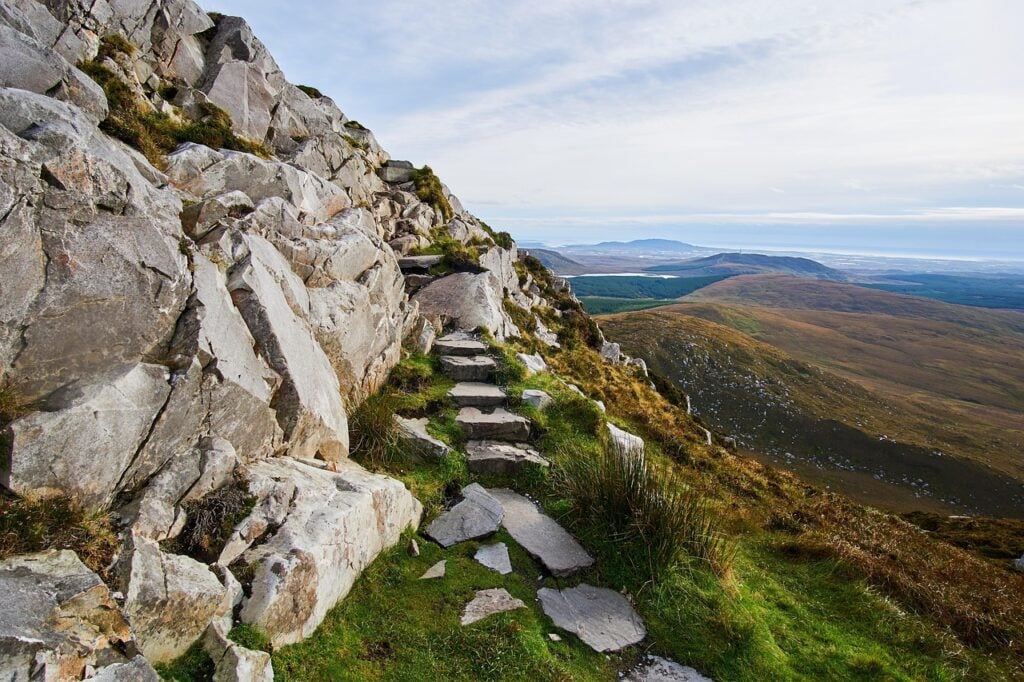
Appearance: Subject appears most often to be simply an ordinary patch of grass — which, of course, is what makes a patch of hungry grass so dangerous: Those who trod upon it will typically not know that they have done so until they have already done it.
[Like what you read? Check out Dangerous Games To Play In The Dark, available from Chronicle Books now!]
One source does offer a slightly more detailed description. Per William Careltone’s 1840 article “Irish Superstitions: Ghosts and Fairies,” published in the Irish Penny Journal in December of that year, “Such spots are said to be generally known by their superior verdure: They are always round, and the diameter of these little circlers is seldom more than a single step” — that is, a patch of hungry grass may be small, round, and especially green and lush.
Modus operandi: Subject’s effect on targets is accurately described by its name: Should a target walk on, over, or through a patch of hungry grass, they will immediately become stricken with a hunger so great, it will sap all of their strength from them; if the curse is not lifted with great haste, targets will expire.
The Irish phrase by which subject is referred — féar gortach — may also be used to describe the effect of subject upon targets: A target under the curse of hungry grass is said to have taken the féar gortach.
Several possible methods for the creation of subject exist. These methods include the following:
- If a meal is eaten upon the grass, and the crumbs of the meal are not left for the fairies, the fairies will curse that patch of grass, rendering it féar gortach;
- If a meal is eaten upon the grass, and grace is not said before the meal, the area becomes féar gortach;
- If a coffin coffin containing the remains of one who has passed on has rested on a spot, that spot becomes féar gortach;
- If someone has died at a specific spot, and fallen face-down such that their mouth has touched the ground, the spot where the mouth touched becomes féar gortach;
- Or, if someone has specifically died of starvation at a particular spot, that spot is rendered féar gortach.
It is not known whether any single possible method is the sole possible method by which subject is created.
More likely, they are all possible at any given point.
Containment: Should a target find themselves having taken the féar gortach, the curse may be alleviated by consuming any amount — even a mere bite — of something edible; indeed, this action should be taken as soon as possible. It is recommended that a foodstuff of some sort be kept upon one’s person at all times, allowing for the easy neutralization of an unwitting encounter with subject whenever necessary.
Additional notes: Although subject’s existence likely stretches far, far back beyond documented times, written documentation of subject may be found beginning in 1834, where it is described in the second series of Irish writer and novelist William Carleton’s multi-volume work Traits And Stories Of The Irish Peasantry. In the third volume of this second series, the tale “Phelim O’Toole’s Courtship” contains several mentions of subject, including both how subject affects targets and one possible method for the creation of subject.
When asked by his father where he has been, the titular Phelim recounts the following:
“Oh, bedad, a terrible thing all out. As I was crassin’ Dunroe Hill, I thramped on hungry grass. First, I didn’t know what kem over me, I got so wake; an’ every step I wint, ’twas waker an’ waker I was growin’, till at long last, down I dhrops, an’ couldn’t move hand or fut. I dunna how long I lay there, so I don’t.”
Phelim is rescued by an elderly passerby, who feeds him a bite of meal, subsequently lifting the curse. His rescuer then tells him, “Now, this is the spot the fairies planted their hungry grass, and so you’ll know it agin when you see it.”
Carleton wrote about hungry grass many times throughout his life, either in laying down old folktales, or in more academic pieces. In his previously-mentioned 1840 article “Irish Superstitions: Ghosts And Fairies,” for instance, he not only offered the physical description of subject offered in the “Appearance” section of this Encyclopaedia entry, but also described one method of creation of subject, the effect subject has upon targets, and how these effects may be alleviated.
With regards to the method of creation, Carleton adheres to the theory that if a meal is eaten and the crumbs are not scattered for the fairies, the fairies will plant a patch of hungry grass in the spot where the meal was eaten. The effects of their curse are such that any who“[pass] over that particular spot forever afterwards is liable to be struck down with weakness and hunger; and unless [they] can taste a morsel of bread, [they] neither will nor can recover.” To break the curse, Carleton writes, the affected person must only “but [taste] as much meal or flour as would lie on the point of a penknife”; doing so will “instantaneously break the spell of the fairies,” allowing the affected person to “recover [their] former strength.”
In 1845, a blight struck Ireland’s potato crops just weeks before the October harvest, devastating the single most important dietary staple in the entire country and causing widespread starvation. The blight continued to destroy the potato yield in Ireland year after year, and between 1845 and 1851, roughly one million people died as a result of the ongoing famine. This period of Irish history became known as the Great Hunger.
Notably, Carleton, who lived from 1794 to 1869, both survived the years of the Great Hunger itself and witnessed its effects on Ireland and its population for years after.
The Great Hunger is likely why there was an increase in discussion of féar gortach beginning in the 1840s and continuing for many decades after. Furthermore, although féar gortach itself predates the Great Hunger, the existing folklore surrounding it combined with the devastating effects of the famine may have given rise to a new, related spectre: The féar gorta, or the hungry man — an emaciated entity stricken with a ravenous, debilitating hunger. Alternative renderings of féar gorta include fairgurtha and fair-gortha; in writings from the late 19th century, the terms féar gortach, féar gorta, fairgurtha, fair-gortha, and other variations are sometimes used interchangeably.
Post-famine documentation of subject is particularly heavy throughout the 1880s and 1890s.
For instance, G. H. Kinahan’s 1881 article “Notes On Irish Folk-Lore,” published in the Folk-Lore Record, tells of the “fairgurtha, or hungry-grass,” wherein subject is described as “tufts of a peculiar grass that grows on the mountains, on which if any one tread he immediately becomes faint and hungry and incapable of walking”; any found expired in the hills, Kinahan writes, “are said to have had the fairgurtha, that is, they stood on a tuft of this grass and lost of the power of going on.”
Kinahan further writes of an incident in which a companion became stricken with the “fairgurtha” as they traversed the hills in Connemara in County Galway:
“Once on the Connemara hills a man with me got faint, and I had to carry or drag him four miles before I got assistance; then I could not get him to eat or drink anything until I had treated him similarly to the way I would have treated a faint dog, that is, forced a spoonful of meal and salt into his mouth, which made him chew; after which he was able to eat a hearty meal. When he first became faint he wanted to lie down and go to sleep. His fairgurtha evidently was due to long fasting.”

1888’s Ancient Legends, Mystic Charms, And Superstitions Of Ireland, written by Lady Wilde, documents a number of odd grasses, and includes an entry on the “fair-gortha, or the ‘hunger-stricken sod’”: Writes Wilde, “If the hapless traveller accidently treads on this grass by the road-side, while passing on a journey, either by night or day, he becomes at once seized with the most extraordinary cravings of hunger and weakness, and unless timely relief is afforded he must certainly die.”
In 1891, Edith Blake drew connections between the folklore of Newfoundland and that of Ireland, particularly the more northern regions: Her article “A Chat About Newfoundland,” published in the North American Review, described hungry grass specifically as a superstition of Counties Mayo and Galway; its presence, she writes, is “said to render it dangerous to traverse the hills of Erris or Tyrawley, in the west of Ireland, unless one has taken the precaution to put a cold potato or two or a piece of bread in one’s pocket.”
She goes on to issue a warning, and a solution:
“Woe betide the man who steps on the hungry-grass without being provided with something to eat; he falls faint from hunger, and speedily expires if he cannot get some food, though a few grains of oatmeal or some crumbs of bread, if within reach, would save his life.”
More than half a century later, however, would come one of the most notable pieces of scholarship surrounding hungry grass to date — particularly with regards to its association not with fairies, but with death. Folklorist Máire Nic Néill’s “Wayside Death Cairns In Ireland,” published in Béaloideas in 1946, asserts that the association of hungry grass with “death-places” is specific to the province of Connacht. Examples of accounts detailing this association include:
- An account collected in North Mayo, which states: “It is believed that there is Hungry Grass in any place where there is a leacht or in any place where a corpse was laid”;
- An account collected around County Sligo, which states: “At the Hungry Rock, highest part of the road leading from the main Ballina-Sligo road to Coolaney in Sligo, a priest is said to have been killed. … If you pass by the Hungry Rock without throwing a stone in on it, you are wantonly exposing yourself to the danger of getting the féar gortach, and as the spot is lonely and isolated from any dwelling-house, getting the féar gortach, there or near it would most likely mean death”;
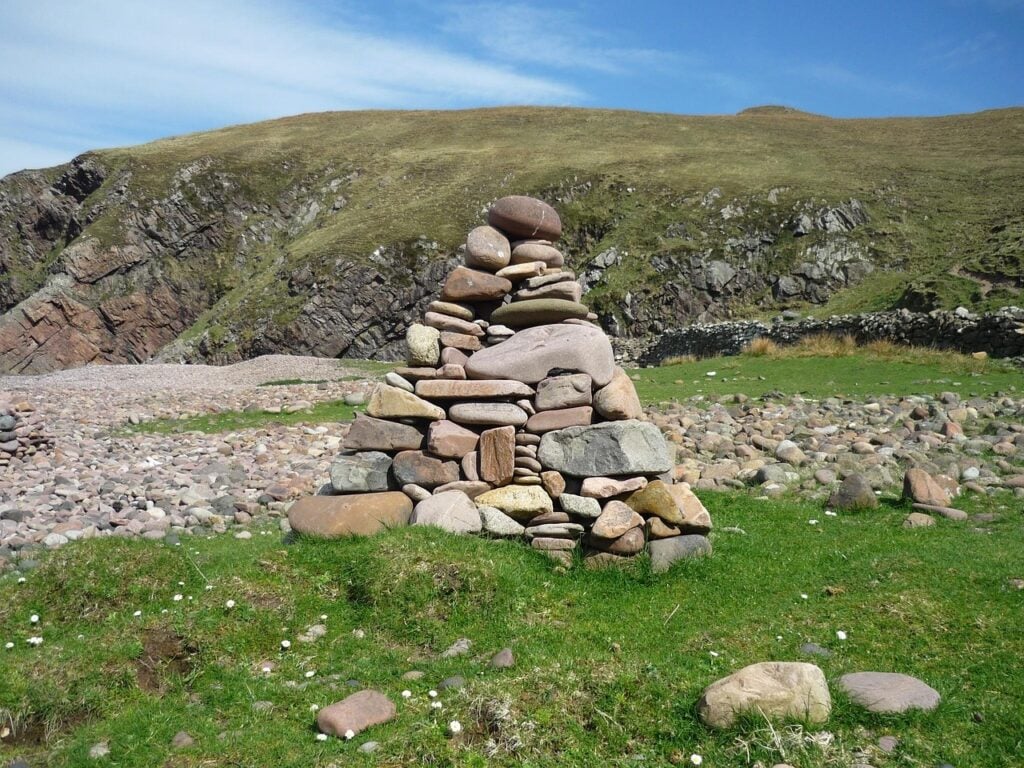
- And an account collected in County Leitrum, which asserts that you might die of hunger if you don’t add a stone to a prehistoric cairn on Benbo mountain when you pass by.
The various beliefs that a patch of hungry grass is created when someone dies and falls mouth downward are also detailed in “Wayside Death Cairns In Ireland,” along with other such possibilities that cairns themselves are built to “give passers-by warning of hungry grass,” and that bread might be thrown upon them to prevent patches of hungry grass from forming.
In a handful of sources — namely Lady Wilde’s Ancient Legends, Mystic Charms, And Superstitions Of Ireland and Máire Nic Néill’s “Wayside Death Cairns In Ireland” — hungry grass is discussed alongside a different grass with similarly mystic qualities: Faud shaughran, stray sod, or fairy grass, as it’s termed by Lady Wilde.
Per Lady Wilde, stray sod causes “whoever treads the path it grows on [to be] compelled by an irresistible impulse to travel on without stopping, all through the night, delirious and restless.”
Meanwhile, two accounts collected by Máire Nic Néill describe a similar phenomenon. According to one, it’s said that “if, crossing a field at night, you were to go where a body fell mouth downward … a kind of confusion would overcome you and … you would go astray in that field;” meanwhile, according to the second, it’s said that “there is a ‘stray’ wherever a coffin rested, i.e., if you stand where a coffin rested, you will go astray.”
Interestingly, in both Lady Wilde’s work and Máire Nic Néill’s, the stories include ways to solve the problem, should a target become ensnared by fairy grass. Lady Wilde notes that it may be neutralized by “another herb” (which she does not name), but also states that “only the initiated can utilize [this herb’s] mystic properties”; meanwhile, the second account collected by Máire Nic Néill notes that those who stand where a coffin rested and find themselves going astra will “not recover your sense of direction until you walk over the same spot again.”
Fairy grass, as it is described in both of these works, bears much resemblance to previous Encyclopaedia subject die irrwurz, the confusion root. It is not known whether they share any actual DNA; further research pursuing possibly connections may be fruitful, although it is beyond the scope of this current report.
Recommendation: Tread carefully, and carry a snack.
You never know when you might need it.
Resources:
“Phelim O’Toole’s Courtship” by William Carleton, in Traits And Stories Of The Irish Peasantry.
“Irish Superstitions: Ghosts and Fairies” by William Carleton, in the Irish Penny Journal.
“Notes on Irish Folk-Lore” by G. H. Kinahan, in the Folk-Lore Record.
Ancient Legends, Mystic Charms, And Superstitions Of Ireland by Lady Wilde.
“Wayside Death Cairns in Ireland” by Máire Nic Néill, in Béaloideas.
“With Death Looking out Of Their Eyes: The Spectropoetics of Hunger in Accounts of the Irish Famine” by Stuart McLean, in the International Journal Of Anthropology.
“The Féar Gortach: Memorialization of the Great Hunger in Irish Folklore” by Sophia DeLeon.
“How The Great Famine Birthed A New Mythological Creature In Irish Folklore” at the Irish Star.
***
Follow The Ghost In My Machine on Bluesky @GhostMachine13.bsky.social, Twitter @GhostMachine13, and Facebook @TheGhostInMyMachine. And for more games, don’t forget to check out Dangerous Games To Play In The Dark, available now from Chronicle Books!
[Photos via NakNakNak, Christian_Birkholz, PDPhotos, kidmoses, Tammienorrie/Pixabay]
Leave a Reply