Previously: Émélie Sagée And Her Mysterious Doppelganger.
The English language Wikipedia page for “Karsikko,” or karsikko tree, is quite sparse: Just a single sentence, a single citation for that sentence, and one image. The page is what’s usually termed a stub, due to its lack of content; as of 2025, roughly half of the articles on Wikipedia are considered stubs. But if you go to the Finnish language Wikipedia page for “Karsikko?” That page opens up a world of detail about funerary rites and spiritual practices.
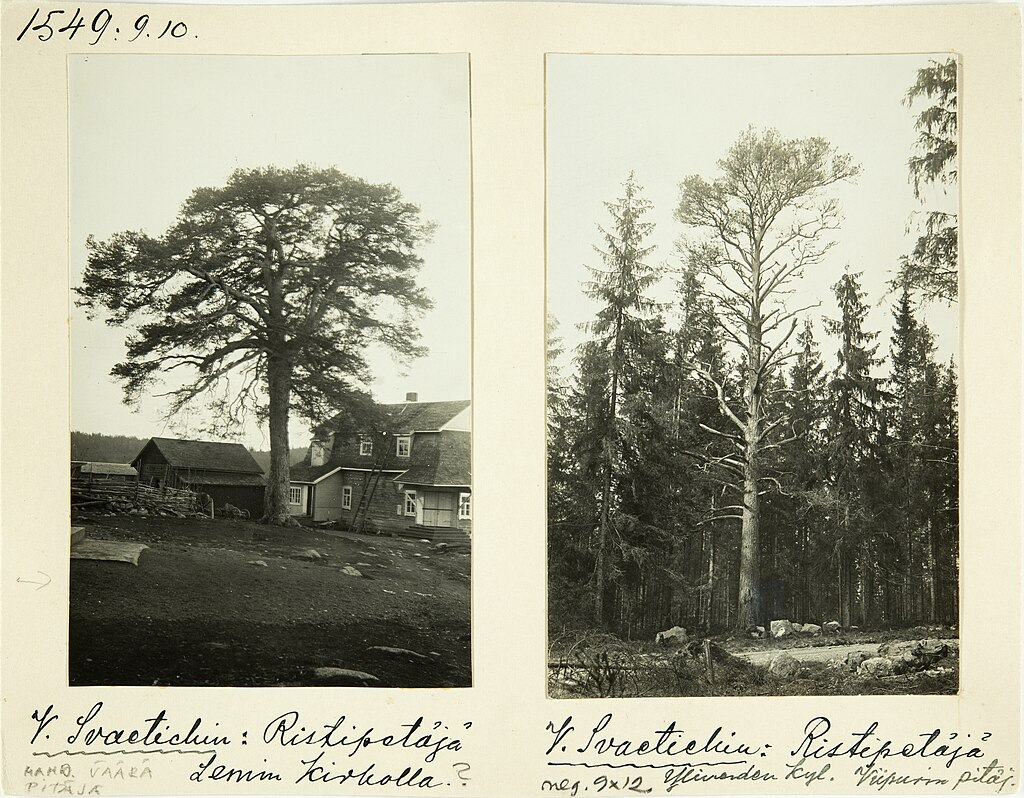
A karsikko tree, you see, is a tree that’s been carved or marked in a highly specific way — and if you make one somewhere between the home of a recently-deceased person and their burial site, it’s said that it will prevent that person’s spirit from returning to — or perhaps getting stuck on — the mortal plane. It helps put their spirit properly to rest, or at least lets them know where not to go now that they should be passing on — or, put more bluntly, it prevents them from returning to haunt the living.
[Like what you read? Check out Dangerous Games To Play In The Dark, available from Chronicle Books now!]
It turns out, though, that there’s a lot more to karsikko trees than just funerary rites; death is just one of the reasons a karsikko might be made. In fact, they can be made for such a wide variety of reasons and under such an equally wide variety of circumstances that they’re probably better described more broadly as a memorial meant to commemorate a significant event — not just as a funerary tradition.
Still, though: The version that associates them with death and the afterlife is arguably the most interesting version — and the one about which the most information is generally available. And, I mean, who doesn’t love a good folkloric death tradition? I know I sure do.
So let’s take a look, shall we?
Karsikkos could actually take a few different forms. Typically, they were made out of living trees — conifers, usually, which had been shorn of some or all of their branches. Indeed, the term “karsikko” itself derives from the Finnish word “karsia,” meaning “to prune,” as in a tree — or, more descriptively, “to debranch.”
If a karsikko tree was only partially debranched, the remain branch or branches held different meanings: Per Matti Sarmela’s Finnish Folklore Atlas, just one branch denoted that the deceased was either widowed or had never married in the first place; two branches signified that the deceased has been married (and, presumably, that their spouse was still alive); or, a branch may have been left that pointed towards the deceased’s home village. Branches may also have been left on either side of the tree, giving the appearance of a cross or a person standing with their arms outstretched. (We’ll get into why in a moment.)
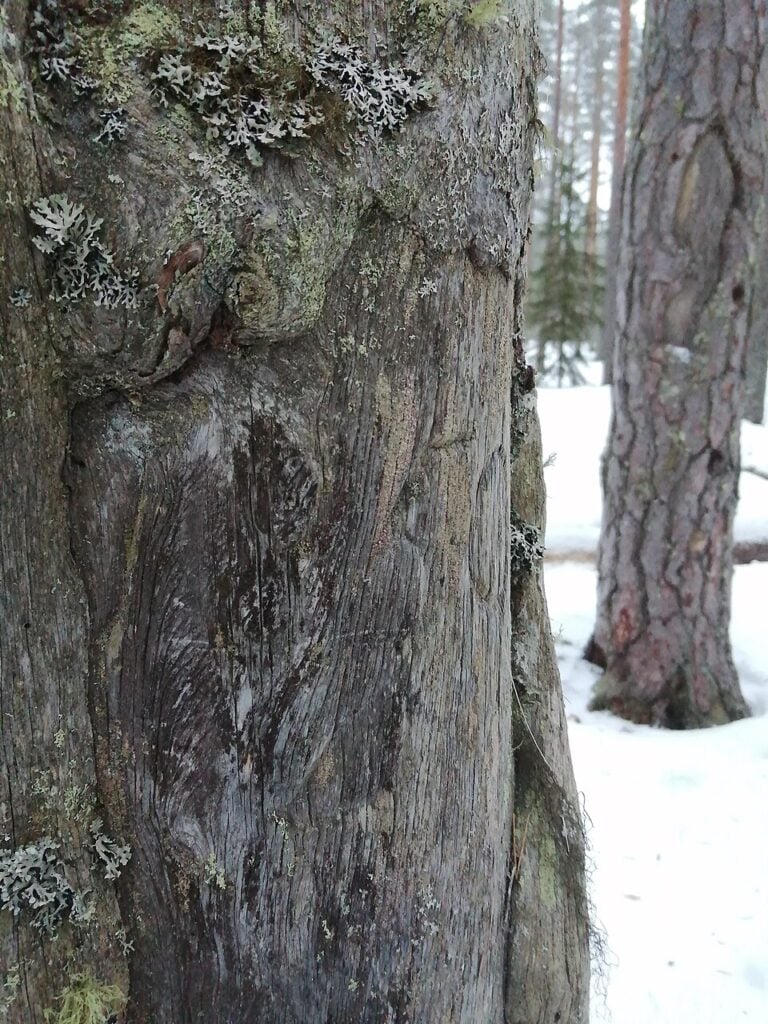
Then, whatever markings had been chosen — usually the deceased person’s name or initials, the year of the death, and the precise date of either the death itself or the burial — would be carved directly into the tree itself, following the removal of bark from the tree’s trunk.
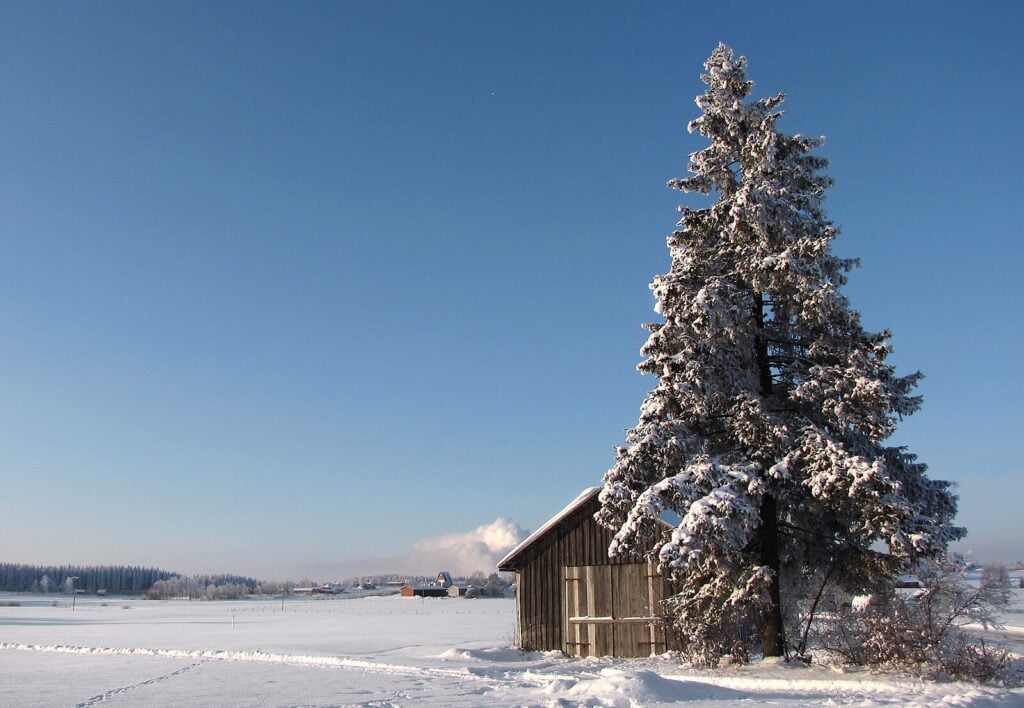
However, in some cases, the markings might also be carved on a separate board and hung on the tree, rather than carved into the tree’s own trunk — or hung or propped on a rock or outcropping, or even hung from the side of an outbuilding on the deceased’s own property.
Traditionally, as Janne Vilkuna describes in his essential work “The Karsikko And Cross-Tree Tradition Of Finland: The Origins, Change, And End Of The Custom,” published in the journal Ethnologia Europaea in 1993, the karsikko would be carved or hung during the funeral procession — that is, midway through the journey from the deceased’s home to the planned site of their burial. At the point where the karsikko came into being, whether it be by carving the markings or hanging the board, those present would have a drink, sing a hymn, and then perform a kind of spell intended to bind the deceased person’s spirit to the tree.
The idea was that it would function as a barrier stopping the deceased’s spirit from returning to their former home — or, per Vilkuna:
“…In addition to the rites of separation, it also had the function of a precautionary measure. It removed the deceased from the community of the living, thus settling the social disorder caused by death and protected the community from a deceased person who might come back to disturb it. It also helped the deceased to remain in the grave and to refrain from wandering.”
Sarmela further notes that, had branches been left such that the karsikko tree looked like a cross or a person standing with their arms open wide, it was meant to “stop the deceased person trying to return home, chasing him back to the graveyard” — that is, it was designed to look like a sentinel so that it could act like a sentinel.
In the case of the karsikko board finding its place on an outbuilding on the deceased’s property, the board would be hung after returning from the cemetery or place of burial. These boards were generally modeled on gravestones.
The tradition of the karsikko tree had a relatively short lifespan, all things considered — the oldest record we have of them dates back only to the late 17th century (and even then, it’s record of a more general Baltic tradition, rather than the specific Finnish one that concerns us here), and by the early 20th century, they were mostly no longer in use. (Interestingly, though, they do still pop up in parts of Estonia from time to time these days.)
But the trees? The trees remain — and some of them have given the forests in which they’re located… reputations.
Take Pyhäkankaan karsikko ja ruumistie, for instance — the Pyhäkangas pruned forest and corpse road (a corpse road being a path forged specifically to facilitate the transportation of the deceased from their homes, or wherever else they may have expired, to their parish church or planned burial ground), located in Saarijärvi in central Finland. According to a trip report published at Out In The Nature — a travel site focused on Finland’s great outdoors—there were once more than 200 karsikko trees in the forest; now, though, only a few dozen remain, all with markings dated between 1833 and 1897. Still, it’s one of the best preserved karsikko forests in Finland, and has been a protected area since 1904.
With so many karikko trees — trees to which souls and spirits have been bound, remember — it’s no wonder that the forest is occasionally said to be haunted. The specifics aren’t often spoken about… but the idea itself is mentioned from time to time.
If you’re feeling adventurous, you could try and see for yourself. The forest isn’t hard to visit — and, indeed, looks to be quite a nice hike — although you do need a car to get there.
If you go, though… just make sure you leave the trees alone.
You wouldn’t want to accidentally release a spirit from one, would you?
Further Reading:
“The Karsikko And Cross-Tree Tradition Of Finland: The Origins, Change, And End Of The Custom” by Janne Vilkuna in Ethnologia Europaea. The quintessential academic work on karsikkos, covering their history, their making, their meaning, and, perhaps most importantly, their evolution over time, including their connection with the similar tradition referred to as cross-trees. It’s very accessible for an academic work.
Janne Vilkuna’s background is in archaeology, ethnology, Finnish history, and art history — fields for which he holds numerous degrees, including a PhD. Among his many professional achievements are tenures as senior curator at the Museum of Central Finland, Jyväskylä from 1980 to 1989, the director of the Jyväskylä University Museums from 1993 to 2016, and professor of museology — the study of museums, including the history of museums, the role they play in culture and society, and essential museum work ranging from curation and preservation to public programming and education — at Jyväskylä University. He has the distinction of having been the first professor of museology in Scandinavia.
Finnish Folklore Atlas by Matti Sarmela (translated by Annira Silver). There’s a ton of info on karsikkos of all kinds in this meaty volume, from the funerary ones we’ve discussed here to the ones used for, say, hunting, or marriage, or other events worth memorializing. I accessed the fourth edition, which was published in 2009; the first edition, however, was originally published in 1994. It won the Finlandia Prize for scientific literature that year.
Matti Sarmela is a cultural anthropologist who has, among his many distinctions, served numerous rules at the University of Helsinki, including professor of general ethnology from 1973 to 1981, professor of social anthropology from 1981 to 1988, and full professor of cultural anthropology — the university’s first — from 1988 to 2000; established the Finnish Anthropological Society; and began the society’s academic journal, Suomen Antropologi ‒ Finlands Antropologi, in 1976.
An example of a karsikko board at the National Museum of Finland. Here’s what a karsikko board looks like. It’s from Simola, in the southeast of Finland. It reads memorializes a person named Marija-Liisaa Nöökelm and notes the age of death as 54 years. The board, notably, has had an overhand incorporated into its construction, so as to protect the carved markings from the elements.
An example of a karsikko tree at the Konnevesi Museum. The Konnevesi Museum in central Finland is an open air museum — always fun to visit! — that has, in its courtyard, a full karsikko tree. It wasn’t created here; the whole tree was relocated to the grounds of the museum. But it’s still neat!
“Are Pyhäkangas Pruned Forest And Corpse Road Haunted?” at Out In The Nature. A full report of a visit to thePyhäkangas pruned forest, with lots of excellent photographs. If you want to see some well-preserved karsikko trees in their natural environment, here’s a good way to do that. This report also has easy-to-follow directions for actually visiting the forest, if that’s something you’re interested in doing.
“Did You Know About This Forest Near Pyhä-Häkki?” at Retkipaikka. (In Finnish.) Another trip report of a visit to Pyhäkangas, again with lots of photographs. This one is written in Finnish, though, so heads up about a possible language barrier.
The Tree Crosses Of Rosma Forest at Atlas Obscura. Remember when I said that cross-trees popped up in Estonia from time to time? Rosma Forest is one of those places. Atlas Obscura’s entry on the location has the rough relevant info, including coordinates if you want to try to visit.
Vermilia, Karsikko. Finnish metal artist Vermilia’s third full-length album, released on Feb.14, 2025, is titled Karsikko, as is the album’s first track. I can only read the lyrics in translation, but even through that imperfect lens, they’re still quite beautiful. Grab the album over at Bandcamp, or check it out on Spotify.
The Man-Eating Tree, “Karsikko.” Another Finnish metal group, the Man-Eating Tree, have a song titled “Karsikko” on their 2011 album Harvest. It’s an instrumental, so there are no lyrics to analyze here, but it’s still a good listen. Check it out at Spotify; “Karsikko” is the 10th track on the album.
The Man-Eating Tree initially put out three albums between 2010 and 2015; then they went on a decade-long hiatus. The band has sort of reemerged in 2025, but not in its original form; only one of its old members remains, with the rest of the lineup new. I’m not sure what may or may not have gone on between 2015 and 2025 for this to be the case, but it is what it is. Under this new lineup, they released their first new album in a full 10 years in 2025, Night Verses.
***
Follow The Ghost In My Machine on Bluesky @GhostMachine13.bsky.social, Twitter @GhostMachine13, and Facebook @TheGhostInMyMachine. And for more games, don’t forget to check out Dangerous Games To Play In The Dark, available now from Chronicle Books
[Photos via Museovirasto, Petritap, Talvipäivänseisaus/Wikimedia Commons, available under CC BY 4.0, CC BY-SA 3.0, and CC BY-SA 4.0 Creative Commons licenses; BioDivLibrary/Flickr, available under the public domain.]


Leave a Reply