Previously: “Nights Of The Night” Cursed Song.
Type: AC (Animated Corpse).
Period/location of origin: In her most recognizable form, subject — known widely to a certain generation as the Girl With The Green Ribbon Around Her Neck, or simply the Girl With The Green Ribbon — originates circa 1984 in the United States. However, subject long predates this particular iteration, and hails from a different region of the world, as well. It is believed that the oldest recorded mention of subject occurs in a French religious pamphlet originally published in 1613.

Appearance: Although she does, in fact, sometimes appear as described — that is, subject may look to be a girl or young woman with a green ribbon worn around her neck like a choker-style necklace — subject’s appearance does not always match her distinctive moniker. She is usually described as beautiful; often, she is described as pale; sometimes, she is a ballet dancer; frequently, she is simply a woman seemingly alone in the world and in a condition that solicits pity from those who meet her.
[Like what you read? Check out Dangerous Games To Play In The Dark, available from Chronicle Books now!]
The ornament tied about her neck, too, may be any number of varieties: It may be velvet, or it may be some other material; it may be plain, or richly decorated; it may be green, or red, or black; it may be festooned with pearls or diamonds, or not; it may feature a silver clasp, or not.
There is, however, always a necklace, ruff, ribbon, collar, or choker tied about the young woman’s neck.
And it always guards her closest secret — one which may only be revealed to others when the time, as it were, is right.
Modus operandi: Just as subject’s appearance is not always the same, neither is subject’s modus operandi identical from account to account.
Subject may deliberately ensnare targets who express amorous intent, or she may simply be in the right place at the right time to attract these sorts of targets — that is, targets may be self-selecting. Regardless, when a target has been matched with subject, subject will go wherever the target leads her: To a hotel; to his home; perhaps even into a marriage. (Targets are almost always men.)
From here, one of two situations may be encountered:
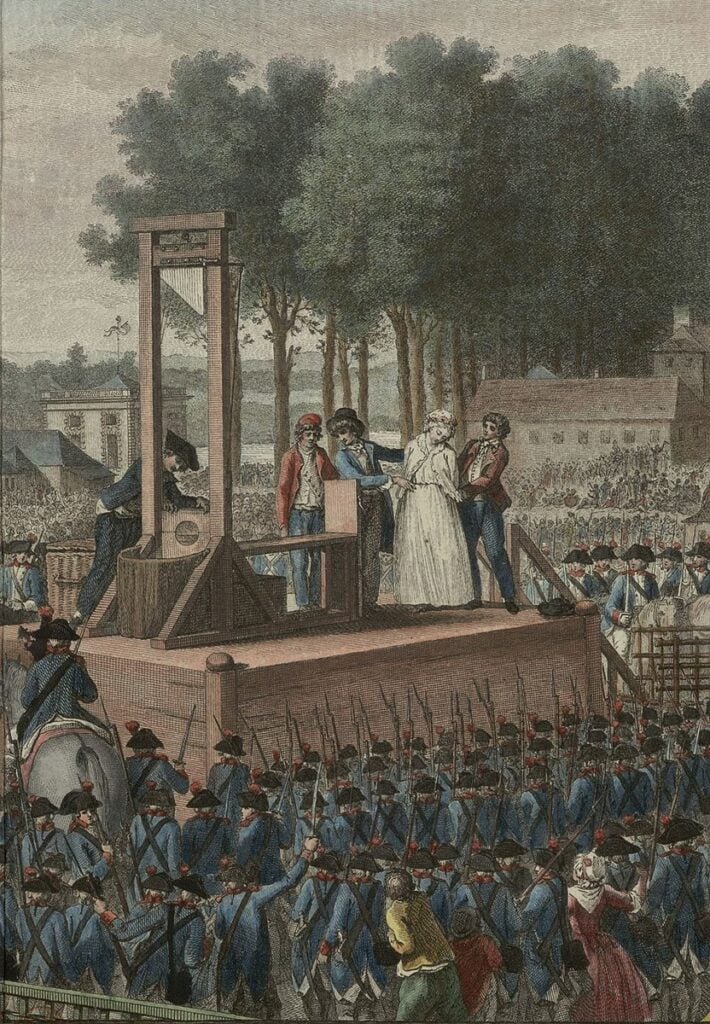
- Should target bring subject to a hotel or to his home and spend the night with her: Target will find in the morning that subject is oddly cold — and, upon further investigation, that she is dead. Should target unfasten the ribbon from around her neck, he will then witness subject’s head fall off and roll some distance away from her body. It will subsequently become clear that subject had died either by guillotine (commonly) or hanging (less commonly) a significant amount of time prior — that is, before target encountered her the night before.
- Should target marry subject: Target may develop a growing obsession with the ribbon. Should target push subject to remove the ribbon, subject will simply say, “You’ll be sorry if I do, so I won’t.” Should target strip subject of her agency and remove the ribbon himself, he will then witness her head falling off and rolling away.
In both situations, target will suffer lifelong psychological ill effects.
In the case of the second, it serves him right.
Containment: Containment is simple: Leave the ribbon untouched, and her head will remain attached.
Additional notes: Subject’s history is long, spanning many more centuries than her most notable form (that is, the Girl With The Green Ribbon Around Her Neck) may suggest.
In fact, the oldest known record of subject occurs in Histoire prodigieuse d’un gentilhomme auquel le diable est apparu, et avec lequel il a conversé sous le corps d’une femme morte, advenue à Paris le 1 janvier 1613 (“Prodigious story of a gentleman to whom the devil appeared, and with whom he conversed under the body of a dead woman, which happened in Paris on January 1, 1613”), a religious pamphlet published in France in the 17th century.
This pamphlet recounts the tale of a rakish young man in Paris who spends the night with a beautiful young woman who wears a pearl necklace around her neck. When he awakes in the morning, he finds her to be cold; she had, it turns out, been hanged some time ago. The pearl necklace she wore had hidden the rope marks about her neck from the young man.
Subject next appears in an 1823 account — this time in English — written by Horace Smith titled “Sir Guy Eveling’s Dream.” This account follows the same outline as the 1613 French account; however, it is stated to have occurred in London, rather than Paris, and the ornament about the woman’s neck is a velvet ruff, rather than a pearl necklace. Subject is ultimately found to have been an Italian woman hanged the week prior.
Note that in these versions of the story, subject’s head does not come unattached from her body, owing to the fact that she is said to have been hanged, rather than beheaded.
Subject is next reported in 1824, in Washington Irving’s story “The Adventures Of The German Student,” which was published in Irving’s collection Tales Of A Traveller. In it, the titular German student, the bookish young man Gottfried Wolfgang, is sent to study in Paris to improve his disposition; notably, he arrives at the dawn of the French Revolution. On a dark, stormy night he encounters a beautiful young woman huddled at the foot of the scaffolding leading up to guillotine in a particular square within the city. She wears a black band clasped with diamonds around her neck. He takes her back to his room and spends the night with her.
In the morning, however, he finds — like Sir Guy Eveling, and the nameless French rake before him — that his companion is now cold. When he fetches the police, the officer recognizes the young woman as someone who had been guillotined the day before. He then unclasps the black band from her neck, thus allowing her head to roll away from her body.

Here, we begin to see a trail of reports that seem to feed into one another: Irish poet Thomas Moore wrote in his diaries that, in June of 1824, he had recounted Horace Smith’s tale to Irving, thinking it “would do well for [Irving’s] ghost stories.” Moore, however, describes Smith’s story as one about “the woman with the black collar, and her head falling off” — the latter portion of which, as previously pointed out, does not actually happen in “Sir Guy Eveling’s Dream” (re: hanging, rather than beheading).
Regardless, “The Adventure Of The German Student” marks the first notable time in publication that subject’s head comes off when her necklace is removed — a detail which remains in all further reports from thence onward.
The outline of “The Adventure Of The German Student” also brings reports of subject back into French, with both several direct translations of the story and three new-but-similar accounts — 1830’s anonymous L’Inconnue, the 1833 poem Une Nuit de 1793 by Henri Latouche, and the1843 Petrus Borel story “Gottfried Wolfgang” — arriving within the next two decades.
After this point, the contents of many reports moving forward diverge wildly from the details provided within earlier accounts. In 1850, for instance, Alexandre Dumas père, author of literary classics such as The Three Musketeers and The Count Of Monte Cristo, published La femme au collier de velours (The Woman With The Velvet Necklace), a novella much greater in scope than any of the previous accounts.
In The Woman With The Velvet Necklace, a young German man named Hoffmann — originally a fictionalized version of real-life writer E. T. A. Hoffmann of The Nutcracker And The Mouse King and The Sandman fame, although later revised to be simply another man with a similar name — goes to Paris at the outbreak of the French Revolution to realize his dream of becoming a director for the stage. He leaves behind his fiancée, Antonia, with promises to stay faithful and not gamble — promises which, naturally, he does not keep.
In Paris, Hoffmann falls in love with the beautiful ballet dancer Arsène, who is also the paramour of notable figure of the French Revolution Georges Danton. Arsène, it should be noted, wears around her neck a velvet band with a silver clasp.
Hoffmann bears witness to a great many things during his time in Paris, among them the execution by guillotine of Madame du Barry; he also does everything he can to win over Arsène’s favor, including engaging in gambling.
Shortly thereafter, however, he finds that Danton has been arrested and Arsène has fled. Hoffmann eventually locates Arsène at the foot of the guillotine scaffold, brings her to a hotel, and spends the night with her.
In the morning, however, he discovers Arsène to be cold. He fetches the doctor, who removes the velvet band from Arsène’s neck — at which point her head rolls off. Arsène has clearly been a victim of the guillotine, although it is not clear how long ago her misadventure may have occurred.
By the conclusion of the novella, Hoffmann has lost everything: His money, Arsène, and even his former betrothed, Antonia, who he learns has died in his absence.
(Note that Alexandre Dumas père should not be confused with Alexandre Dumas fils — his son, also an author, among whose works include La Dame aux Camélias. Additionally, the real E. T. A. Hoffmann had been deceased for nearly 30 years at the time of The Woman With The Velvet Necklace’s publication; he passed away in 1822.)
It is not known whether Dumas and Irving had a shared inspiration for their stories; interestingly, though, Irving’s story has occasionally been republished with a title more reminiscent of Dumas’, as in the February 1927 issue of the magazine Weird Tales: Here, “The Adventure Of The German Student” is instead titled “The Lady Of The Velvet Collar.”
Gaston Leroux, best known for penning The Phantom Of The Opera, offers the next account of subject in 1924’s “La femme au collier de velours” (“The Woman With The Velvet Collar”). Featuring nesting narratives, this account does not save subject’s head falling off as a “gotcha” or sting at the end of the story; when we are first introduced to her, it is with the knowledge that many swear they saw her guillotined, and believe the velvet ribbon she wears about her neck now to be the only thing keeping her head attached.
The story within the story, meanwhile, also offers a different plot than those previously recorded. The woman is Angeluccia, wife of Antonio, the mayor of Corsica. When her husband discovers her infidelity with her cousin, Guiseppe, Antonio throws a costume ball featuring a real guillotine from the French Revolution he has recently acquired; he convinces Angeluccia to dress as Marie Antoinette, telling her they can rig the guillotine such that it will provide quite the show to their guests. Little does Angeluccia — or any of the partygoers — know that Antonio intends to behead her for real… and when the guillotine blade falls, many swear they see her head hit the basket.
And yet, this account offers us both natural and supernatural possibilities as explanations: Perhaps she was not actually beheaded, but merely injured at the top of the shoulders due to poor placement within the guillotine; the velvet ribbon, this explanation states, serves to hide the scar that remains as proof of her transgression. But then again…
…Perhaps Angeluccia’s ribbon is best left where it is.
By the late 20th century, the details surrounding the accounts of subject changed again, with the pendulum of complexity swinging back towards the simpler end. In 1970 and 1977, respectively, subject appears in Ann McGovern’s collection Ghostly Fun in an account titled “The Velvet Ribbon” and in Judith Bauer Stamper’s collection Tales For The Midnight Hour under the title “The Black Velvet Ribbon.”
In both of these stories, a man meets a beautiful woman who wears a velvet ribbon about her neck and falls in love with her. After he marries her, however, he becomes fixated on the ribbon, repeatedly asking her to remove it. Each time, she says merely, “You’ll be sorry if I do, so I won’t.”
But he is obsessed, and finally, he betrays her: While she sleeps, he takes a pair of scissors and cuts the ribbon from her throat.
Her head falls off and rolls away, repeating, “You’ll be sorry” as it does.
An account from 1984 gives us subject in her most recognizable form: The Girl With The Green Ribbon Around Her Neck. This account is titled simply “The Green Ribbon”; it occurs in the collection In A Dark, Dark Room by Alvin Schwartz, best known for the Scary Stories To Tell In The Dark series. It is, perhaps, the simplest version yet.
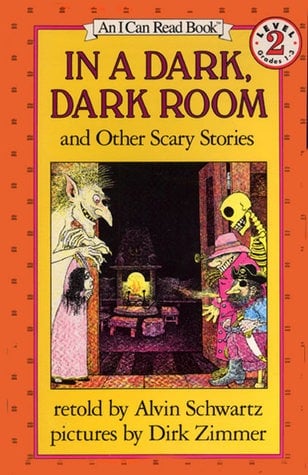
A boy, Alfred, and a girl, Jenny, grow up together. As they reach adulthood, they fall in love, and they marry.
Throughout all the time Alfred has known Jenny — all their lives — she has worn a green ribbon around her neck. He occasionally asks her about it, inquiring not about whether she will allow him to remove it, but about why she wears it in the first place. She replies, variously, that she cannot tell him, that it is not important, and that she will tell him only when the time is right.
They grow old. Jenny grows sick. And before she says farewell forever, she finally reveals to Alfred why she wears the green ribbon around her neck:
On her deathbed, she unties it — and her head falls off.
The ribbon is green again in Carmen Maria Machado’s account of subject, “The Husband Stitch,” published in the literary magazine Granta in 2014 and again in her 2017 collection Her Body And Other Parties. Here, subject — our narrator this time — is hounded repeatedly by her husband throughout their marriage to remove her ribbon. Finally, after giving him everything else she has to give, she gives him this, too — and that is where the horror lies.
Then, it is red in E.M. Carroll’s “A Lady’s Hands Are Cold,” published in 2014 in their comic collection Through The Woods. This account brings in elements from previous Encyclopaedia subject Bluebeard’s M.O., but with a further vengeful twist.
Each iteration of subject — each new account, from each new time period — reveals different concerns of the era, from fears of political unrest to issues of bodily consent. For detailed discussion of these concerns and the various ways reports of subject may be interpreted, please see Maria Beliaeva Solomon’s excellent article “Fatal Attraction: Loving the Guillotined Woman, from Washington Irving to Alexandre Dumas,” published in the journal French Forum in 2022.
A final note: Although subject has, for the purposes of this Encyclopaedia, been classified as an Animated Corpse, it is not clear whether subject is always this, precisely. Subject may be a reanimated body, of course; however, subject may also be a ghost — an echo of who she was when she was alive, before her head parted from her body. Subject may even be somewhere between dead and alive, with the ribbon being the sole line between the two states, both literally and figuratively.
Further research may be required to reach a more accurate classification; however, this research will require fieldwork outside the scope of this current report.
Recommendation: Let her keep her ribbon.
It’s not for you to remove.
Resources:
“Fatal Attraction: Loving the Guillotined Woman, from Washington Irving to Alexandre Dumas” by Maria Beliaeva Solomon.
“The Girl With The Green Ribbon: A Tale of Many Lives” by Kelly Jensen at Book Riot.
“The Girl With the Green Ribbon: A Grisly History of ‘Headless Woman’ Stories” by Ellen Gutoskey at Mental Floss.
Histoire prodigieuse d’un gentilhomme auquel le diable est apparu, et avec lequel il a conversé sous le corps d’une femme morte, advenue à Paris le 1 janvier 1613 (17th century account).
“Sir Guy Eveling’s Dream” by Horace Smith (1823 account).
“The Adventure Of The German Student” by Washington Irving (1824 account).
La femme au collier de velours by Alexandre Dumas père (1850 account).
“La femme au collier de velours” by Gaston Leroux (1924 account).
“The Velvet Ribbon” by Ann McGovern (1970 account).
“The Black Velvet Ribbon” by Judith Bauer Stamper (1977 account).
“The Green Ribbon” by Alvin Schwartz (1984 account).
“The Husband Stitch” by Carmen Maria Machado (2014 account).
“A Lady’s Hands Are Cold” by E.M. Carroll (2014 account).
***
Follow The Ghost In My Machine on Bluesky @GhostMachine13.bsky.social, Twitter @GhostMachine13, and Facebook @TheGhostInMyMachine. And for more games, don’t forget to check out Dangerous Games To Play In The Dark, available now from Chronicle Books!
[Photos via Jon Tyson/Unsplash; Wikimedia Commons; Project Gutenberg; the Internet Archive]
